I have watched Citizen Kane somewhere between a dozen and two dozen times. So it’s hard to say I have just one favorite scene or line of dialogue. (There are enough bon mots in that script to fill a whole song.) But I particularly enjoy the scene in which the late Charles Foster Kane’s estranged best friend, Jedediah Leland, is being interviewed in the retirement home, as he snarkily recounts Kane’s most humbling scandal: “He was always trying to prove something. That whole thing about Suzie being an opera singer? That was trying to prove something. You know what the headline was the day before the election? ‘CANDIDATE KANE FOUND IN LOVE NEST WITH—quote—“SINGER”—unquote.’ He was gonna take the quotes off the ‘SINGER.’ ”
Far be it for me to compare our mightiest 21st-century pop star to cinema’s most legendary 20th-century megalomaniac, but Citizen Swift, too, is always trying to prove something. And as I was saying a few months ago, shortly after she released her record-breaking album The Life of a Showgirl, when it comes to the charts, she likes to win. When she announced the LP—co-produced by Swift with Swedish pop craftsmen Max Martin and Shellback, her collaborators from her peak mid-’10s pop LPs Red, 1989, and Reputation—she knew what her fans were anticipating, and what the headlines were saying: “SWIFT TO REUNITE WITH 1989 MASTERMINDS! ‘BANGERS’ EXPECTED!” OK, no article had that exact headline—but it accurately captures the gist of what everybody, Swift and her fiancé included, were proclaiming in the feverish weeks before launch day.
Then the album arrived—and the Swiftie sniping ensued: Where were the bangers? Sure, the album was catchy enough, but to hear the online hordes tell it, there’s no “Shake It Off” on Showgirl, no “Blank Space,” no “Style” or “Bad Blood.” The comparisons to 1989 seemed especially damning, because Swift’s peak-pop album wasn’t just a bestseller; it was packed with serious hits. Three of its singles—“Shake,” “Blank,” and “Blood”—reached the top of the Hot 100, making 1989 the only Swift LP to generate more than one No. 1 pop hit. Of the other 10 Hot 100 toppers Swift racked up between 2012 and 2024, each came from a separate album (including one each from her Taylor’s Version rerecordings of Red and 1989). It seemed the only way Swift could top the Hot 100 was to ride the first-week hype that accompanied each of her new LPs—except for the original 1989, the miracle hit-generator.
But like Charlie Kane building an opera house just so his wife could perform in it, Taylor was going to demonstrate something about Showgirl to all us naysayers: She bought herself a second No. 1 hit. Well … to be exact, she got her Swiftie army to buy it for her. As Jedediah Leland might say, Swift was gonna take the quotes off the “BANGERS.”
I know I sound as snarky as ol’ Leland about all this—but here’s where my Kane analogy falls down. That second Showgirl No. 1 hit? It deserved to go to No. 1. It’s a real hit. It’s hardly my favorite Swift hit, and yes, she worked her wizardry to get it there; but she pushed a song to the top that earned its place. Susan Alexander Kane may only be a quote-unquote “singer,” but “Opalite” is a quotes-free, chart-endorsed BOP.
The perkiest ditty on Swift’s latest album—which is saying something, because it’s a very jaunty album—“Opalite” is like a one-woman girl-group song. Swift was already giving off ’60s girl-group energy in the video for the LP’s first single, “The Fate of Ophelia”; among the many costumes Taylor tries on in that time-traveling visual, one of them is an homage to vintage Ronettes. But “Opalite” bakes that Ronettes homage right into the song. The chorus is built around a percolating three-note progression that attaches itself to your frontal lobe: “It’s. All. Right. / You were dancing through the light-ning strikes / Sleepless in the o-nyx night / But now the sky is o-pa-lite/ Ooh-WHOA-oh-oh-oh …” That last WHOA-oh is a pretty direct lift of Ronnie Spector’s stickiest hook from the Ronettes’ classic “Be My Baby,” an immortal No. 2 hit from 1963 that the Beach Boys’ Brian Wilson called “the greatest record ever produced.” As I’ve discussed on my podcast Hit Parade, imitating the Phil Spector–produced “Be My Baby” is an evergreen trick that past hits from Billy Joel to Meat Loaf to Eddie Money have pulled in their quest for pop immortality. (In music, if you steal, steal from the best.) On “Opalite,” the allusion to “Be My Baby” has additional lyrical resonance, as the song is basically a dedication to Swift’s own baby, Travis Kelce. Opal is Kelce’s birthstone, and to Swift, the artificial gem opalite is a metaphor for making one’s own happiness.
From the moment “Opalite” arrived with the Showgirl album in October, it’s been the lady-in-waiting to the lead single “The Fate of Ophelia.” Because Swift’s LPs now routinely monopolize the Hot 100 when they drop, Showgirl’s 12 tracks predictably took over the top 12 spots in its first week, among them “Ophelia” at No. 1 and “Opalite” at No. 2. Swift’s consumption stats are so much bigger than any other current pop act’s that that kind of chart takeover is now expected, but what’s remarkable this time is what “Ophelia” and “Opalite” did in the months after their debut. “Ophelia” racked up an impressive 10 weeks at No. 1, Swift’s longest command of the Hot 100 in her career to date. (Join me in pouring one out for her prior record-holder, the eight-week No. 1 “Anti-Hero,” which I still think is the superior song.) But in a way, what “Opalite” did was even more exceptional—it stuck close. The song spent its first eight chart weeks in the Top 10, most of them in the Top Five, before the usual December stretch when Christmas songs take over the Top 10 and eject all of the current hits. Then in January when the holiday songs fell away, “Opalite” leapt back into the Top 10 and stayed there seven of the next eight weeks, never falling lower than No. 11.
No prior Taylor Swift single had this chart pattern. Sure, several Swift songs have staged impressive chart comebacks—like Red’s “All Too Well,” which became a chart-topper nearly a decade after it was first released, when Taylor rerecorded and expanded it, or Lover’s “Cruel Summer,” which was revived by the Eras Tour and staged a post-pandemic march to No. 1, four years after its initial 2019 release. But in both of those cases, the songs essentially disappeared and became sleeper fan favorites before their revival as big hits. That’s not what “Opalite” did—it was behaving as a de facto hit continually, for nearly five months, shadowing “Ophelia” and waiting its turn. Fans were organically streaming it, and radio stations playing it, without any effort on Swift’s part.
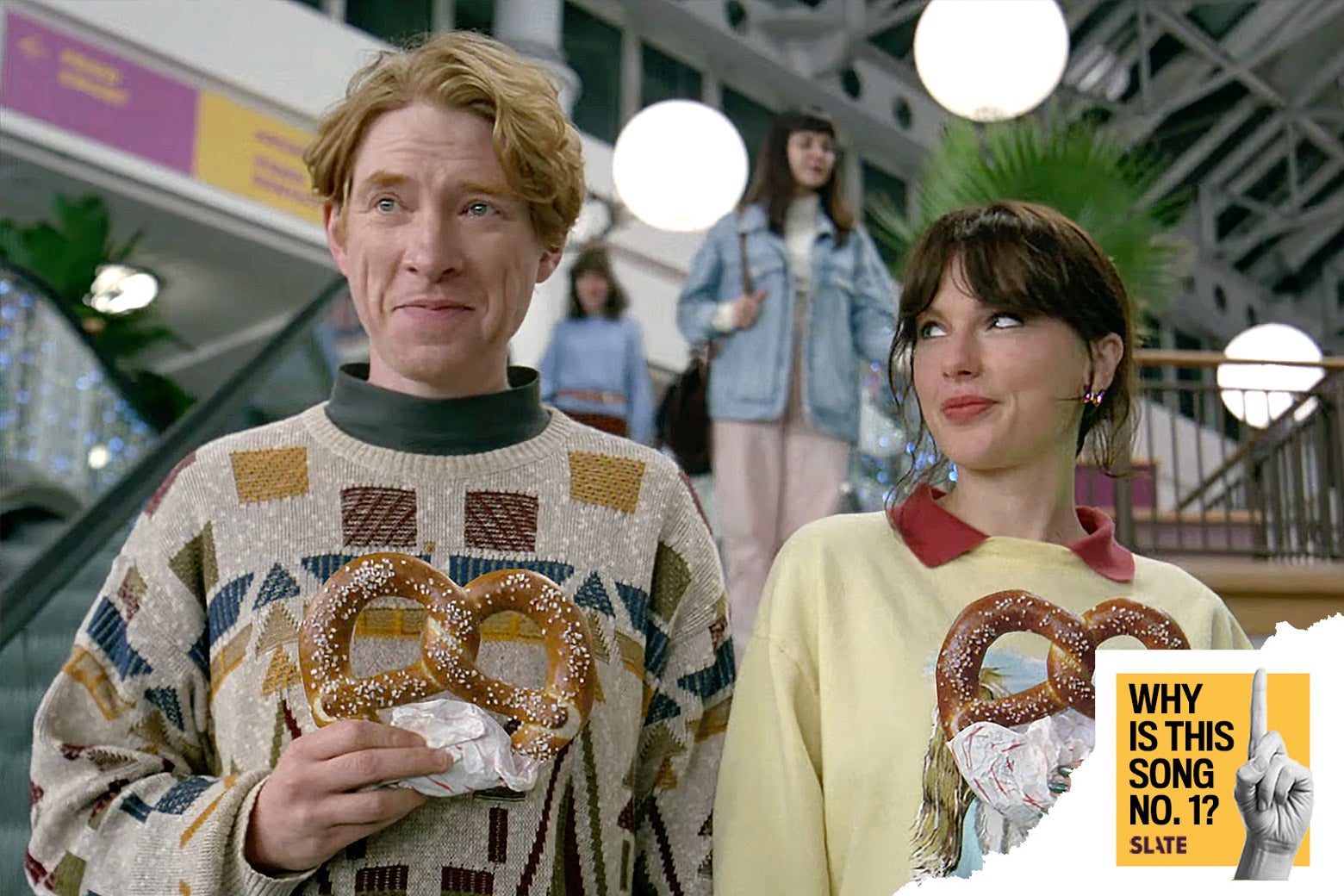
So of course, eventually, Swift gave the song a nudge. The initial promotional bump was the music video, whose backstory is probably more fun than the video itself. The concept seemingly formed in Swift’s brain last fall when she appeared on British TV’s The Graham Norton Show. If you’ve never had the pleasure of watching Norton’s boozy, convivial chat show, he assembles each episode like a dinner party, inviting motley groups of celebrities to assemble on a single living room–like set. On Swift’s most recent Norton appearance, she appeared alongside Lewis Capaldi, Greta Lee, Cillian Murphy, Jodie Turner-Smith, and Domhnall Gleeson, who by all signs sparked Swift when he jokingly quipped that he was hoping to appear in a Swift music video. In the Norton clip, you can see Swift apparently having a brainstorm in real time when Gleeson says this. About four months later, all of that night’s Norton guests, plus Norton himself, make appearances in the “Opalite” video. Set in the 1990s, the strenuously amusing clip co-stars Swift and Gleeson as a pair of wallflowers who have bonded with inanimate objects—a pet rock and a cactus, respectively—before forging a bond with each other.
Because Swift is always, always paying attention to music-industry minutiae and chart strategy, when the video dropped in early February, she did not make it available on YouTube for the first couple of days. Why? Billboard and YouTube are currently in a fight over how Billboard tallies its charts—YouTube is arguing that the magazine undercounts ad-supported plays across streaming services, while the music industry contends YouTube still underpays its artists—and as of January, YouTube is withholding its data from Billboard’s charts. Accordingly, Swift launched the “Opalite” music video on Spotify and Apple Music, knowing those plays would count for the Hot 100. But there are limits even to Swift’s power, because the clip happened to arrive the same week Bad Bunny played the Super Bowl halftime show. As Benito slammed multiple songs into the Hot 100’s Top 10, the release of Swift’s new video only got “Opalite” back up to No. 8.
So then Swift deployed her second, not-so-secret weapon: her Swiftie army’s hunger for new collectibles. Truthfully, Swift had always planned to release “Opalite” as an official, physical retail single. Back in late January, she put on sale not only 7-inch vinyl singles of the original track but also some thumping dance remixes on compact disc by remixers Chris Lake, Skream, Ely Oaks, and Bunt. She even offered an acoustic version as both the B-side of the vinyl single and on iTunes at a discounted price of 69 cents. These products were planned months ago—what changed in February, in the wake of the Bad Bunny chart explosion, was the ship date of these collectibles. Billboard counts physical music for the charts not when it is ordered but when it ships, and so Swift and her label delayed shipment of the singles for the week after the Super Bowl.
This massive retail drop made all the difference. These days, normally, streams are what send hits to No. 1, but “Opalite” currently ranks only 17th among streaming songs—that’s strong but not exceptional. The sales were what did the trick. In the most recent chart week, “Opalite,” across all its versions, sold 168,000 copies—144,000 physical and 24,000 digital. Those are eye-popping totals in an era when the top-selling download in any given week might sell less than 10,000 copies. Between those sales and “Opalite’s” ongoing, ever-growing radio airplay—since October, it has never left the Radio Songs chart and now ranks third among all airplay hits—the song made an easy jump on the overall Hot 100 from No. 8 to No. 1. That, by the way, makes it Swift’s 14th career No. 1 on the Hot 100, pulling her even with Rihanna on the all-time list. (Tay and Rih are behind the Beatles, still tops with 20 No. 1s; Mariah Carey with 19; and, counting No. 1s on Billboard’s pre–Hot 100 predecessors, Elvis Presley with 17.)
So: Swift the mad chart scientist strikes again, right? Sure, but she is far from the only artist who’s had to work the angles to make an album’s second single a chart-topper. As I’ve discussed numerous times in this Slate No. 1 hits series, follow-up singles are hard to promote in the digital era. It’s a scarcity problem—more to the point, a lack of scarcity.
In the analog era of hitmaking, second singles went to No. 1 all the time: from Stevie Wonder’s “You Are the Sunshine of My Life” to Fleetwood Mac’s “Dreams,” Michael Jackson’s “Billie Jean” to Wham’s “Careless Whisper,” Mariah Carey and Boyz II Men’s “One Sweet Day” to ’N Sync’s “It’s Gonna Be Me”—all follow-up hits, all chart-topping singles. When the recording industry controlled the selection of singles to promote and the flow of physical product, they could build a campaign around a second, third, or even seventh single, months after an album dropped, and push it to No. 1. But that control ended a couple of decades ago, when digital downloading broke apart the album into interchangeable tracks. When an album is released, all the songs are available for individual consumption. So modern pop stars have to get awfully clever to get a follow-up single to No. 1—whether that’s via a viral dance challenge, a guest vocalist, or a celebrity-studded music video.
Swift herself has tried several of these tactics—witness the Kendrick Lamar guest rap on “Bad Blood” in 2015, and the celeb-packed “Opalite” clip this year. But the truth is, that Graham Norton–sparked video only did so much for “Opalite”—the retail drop is what got it to the top. Still, Swift wouldn’t have sold more than 100K copies of the song if it hadn’t genuinely built a base of support over many months, independent of any promotional gambit. In this way, “Opalite” has more in common with “Cruel Summer,” a song that organically won favor with fans and eventually the masses, making the leap from fan-beloved album cut to chart-topping smash. That’s a rare thing in the modern chart system, and Swift has now pulled it off twice.
So maybe we all need to show The Life of a Showgirl a bit more respect: Its first single topped the Hot 100 longer than any Taylor Swift song in history, and its second single rose to No. 1 … well, partially because Swift is clever with shipping dates, but mostly because folks genuinely liked it and kept playing it for months before it was even tapped as a single. Two No. 1s from the same album is nothing to sneeze at: Reputation, Lover, Folklore, Evermore, Midnights, and Tortured Poets—none of them pulled that off. Charles Foster Kane may insist that people will think “what I tell them to think,” but he never does win that election, or convince the world that his second wife is a “singer.” Citizen Swift, meanwhile, may have engaged in some chicanery to put “Opalite” on top, but it only prevailed because it already had the support of the people.