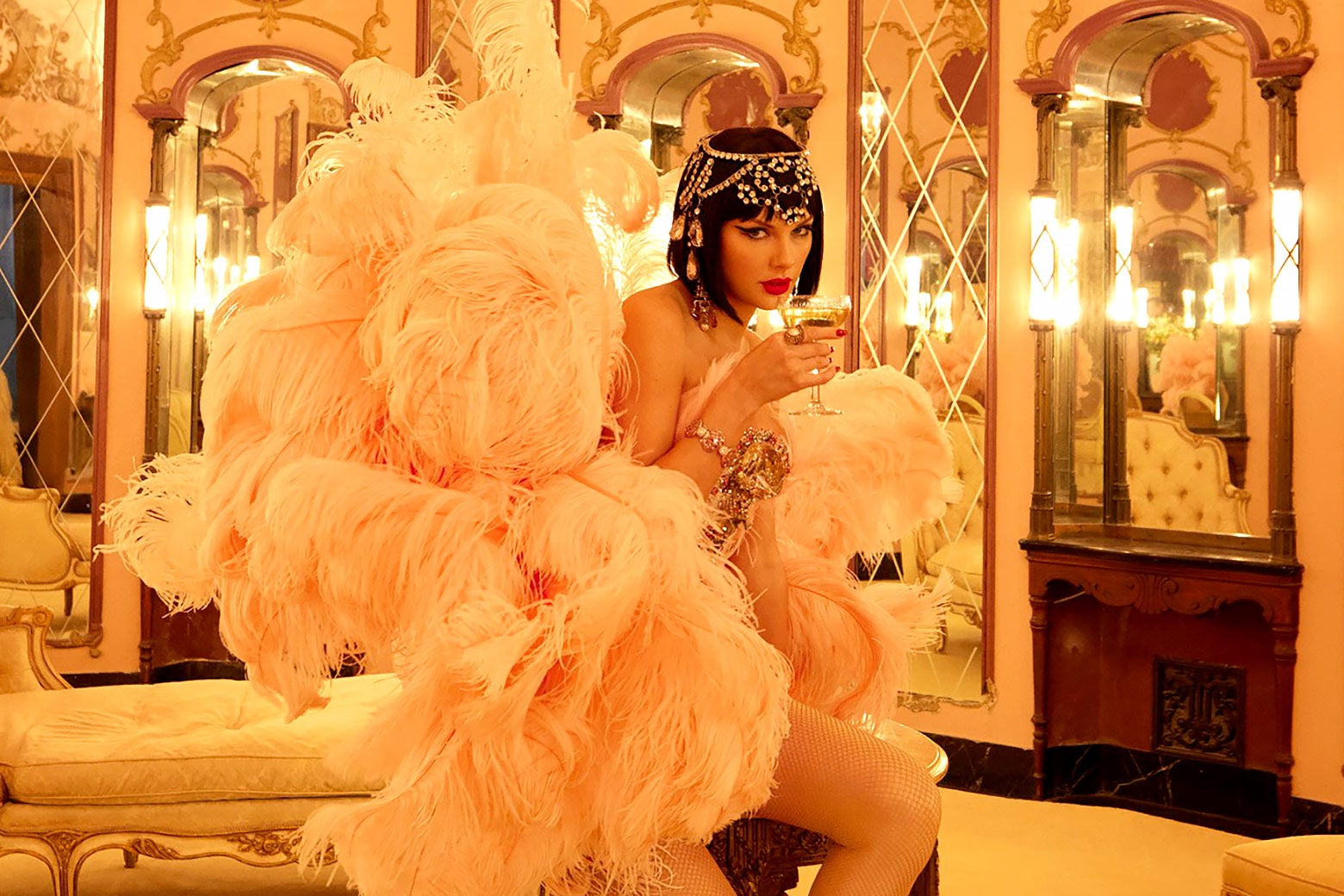
In last year’s sweetly devastating Las Vegas melodrama The Last Showgirl, Pamela Anderson’s middle-aged dancer Shelly is on an audition for the first time in decades. Her long-standing gig, the classic revue Le Razzle Dazzle, is shutting down. She allows that many people would consider her too old for this prospective new part (while still lying about her age). But it’s a huge theater, she jokes: “Distance helps!”
This year’s The Life of a Showgirl marks the first time I might also say “distance helps” about a Taylor Swift album. It’s not that Swift at 35 has by any means aged out of her own role of World’s Biggest Pop Star—if anything she’s still acting too young. No, I mean that this record, her first reunion with Swedish mega-producers Max Martin and Shellback since 2017’s Reputation, feels much more enjoyable if you just let it wash over you in a sunny haze. Swift has always cultivated among fans their minute attention to her lyrical details. But the closer one looks at many of these tracks, the less compelling they often become. Off-putting, even.
Instead, this album’s virtues are in its surfaces, shinier and more accessible than on her past few, more languorous and twisty records. If some of the lyrical choreography has grown hackneyed, focus on the beads and sequins.
One issue is simple overexposure. It’s been only a year and a half since Swift’s previous album, The Tortured Poets Department, unfurled its 31-song parchment. That was in the middle of the box-office-record-breaking “Eras” tour that kept Swift in stadiums and the whole world’s news and social feeds pretty much daily from March 2023 to December 2024. This album was apparently recorded piecemeal between dates on that tour’s final European leg last year. Now it arrives timed to the news cycle around Swift’s announcement a few weeks ago of her engagement to Kansas City Chiefs tight end Travis Kelce. (On one of this album’s cringiest songs, the unsubtly titled “Wood,” Swift informs us that it’s not his end that makes Kelce’s pants so tight.)
The sales and charts records set by this twice-over billionaire have become too familiar to recite. But as context for listening to The Life of a Showgirl, I would draw your attention to one particular data set: In the past five years, Swift released four new albums before this one; plus four of her “Taylor’s Version” re-records of older albums, each with a raft of previously unreleased (“from the vault”) bonus songs; and a few scattered other singles. By my possibly incomplete count, before this morning’s release she’d already put out 111 new songs since 2020. How likely was it that another dozen would come as startling revelations?
In short, they don’t. Most of what we hear on TLOAS repeats themes and variations from across Swift’s recent career. And when they do make a departure, it’s often not for the better (viz. the aforementioned “Wood”). As expected, the happy coupledom occasions a bunch of love songs more upbeat than on Midnights or TTPD, but to me they don’t have the smack of wide-eyed ecstasy of their counterparts on 2019’s often underrated Lover. That may be an unrecapturable sensation of youth. But they also lack the dramatic tension of the fraught love stories in the back half of Reputation.
Neither are most of them quite the classic Max Martin bangers with melodies “so infectious that you’re almost angry at it” that the advance hype set us up to expect. Opener “The Fate of Ophelia” and third track “Opalite” get closest, in their choruses and bridges, although their verses are dull by comparison. Many of the songs here do benefit from following Martin’s signature “melodic math,” in which the words are required to fit exactly to the music in ways that enhance their listenability tenfold, a discipline Swift ignored on many recent albums. Still, there are just as many standout melodic hooks on songs she’s written with Jack Antonoff and others in the past eight years.
Certainly none here are stern-to-bow juggernauts of pop efficiency like “Blank Space” or even, say, “New Romantics.” Perhaps it’s silly to hope for that—again, some moments can’t be repeated—but most of the songs also don’t offer the prolixly oddball left-field inner monologues of the best of Tortured Poets Department. This document of Swift’s supposed happy ending instead has an in-betweenness that makes it hard to revel in her purported satisfaction.
Maybe that’s because they were written and recorded with too much haste and determination and not enough time and space to process. But where she’s coming from might also be getting harder to identify with, as she’s less and less the big-sister songwriter sharing her struggles and more the nonpareil superstar issuing communiqués. This reaches laughability on a song like “Wi$h Li$t,” in which she goes on about how other people want designer clothes, awards, “bright lights,” and “that video taken off the internet,” and God bless ’em, but Swift wants only her baby, aka “a best friend who I think is hot,” a couple of kids, and “a driveway with a basketball hoop.” As if Taylor Swift has ever not wanted all the fame, all the money, all the credit, and all the control she’s always known she has coming to her. With what seems like a pretty good heart and decent values compared to the truly malevolent narcissists of the world, sure. But come on.
Lest you think true love has transformed her into a whole new woman who no longer cares for all of that, The Life of a Showgirl also includes a fistful of the score-settling songs that are Swift-album standard issue. There’s no denying the force of Swift’s greatest revenge songs, of course. But there’s also no wishing away the penny-ante petulance of many of the others. And that’s mostly what we have here, with “Actually Romantic” becoming notorious overnight as the song in which Swift punches down at Charli XCX in response to a song that did not actually attack her. Whatever else might have provoked Swift behind the scenes, she also mounts her attack in the most middle-school way. Sure, she scores a couple of good cracks (“Like a toy Chihuahua barking at me from a tiny purse/ That’s how much it hurts”). But the whole Ooh, you’re so obsessed with me, do you loooooove me? shtick directed at another woman just reminds me of the time Swift sick-burned an ex-boyfriend in a song by saying she’d tell all her friends he was gay. And why is the whole track set to the exact chord riff of the Pixies’ “Where Is My Mind?,” including the little stutter-stop at the beginning?
Even worse is “CANCELLED!” Stylizing a title with capitals and an exclamation point is something Swift’s done before only with “ME!,” so that’s obviously a bad sign. Was this track actually a “vault” leftover intended for the Reputation re-record that will probably never happen now that Swift has been able to buy back her original masters? Frankly, I’d rather think so than that she’s actively returned for an umpteenth dredge at the long-drained well of her brief disfavor over her feud with the West-Kardashians—a couple that no longer exists, and one of whom has for years now been in far greater disgrace than Swift ever was. But the greater offense is the out-of-touch way she savors the word canceled, as if that were still a fresh idea. As if, in fact, she weren’t putting out this record when the American government is subjecting journalists, academics, her fellow entertainers, and other undeserving citizens to much more extreme threats to their reputations and freedom of speech than Swift and her squad members have ever faced in their cushy lives. It makes the song not just bad but infuriating.
There is a revenge song that works here, though, and, improbably, it’s her victory lap about her music-ownership rights dispute with her former label head and business partner Scott Borchetta. The song is “Father Figure,” featuring a very low-key interpolation of the George Michael song of the same name. It benefits partly from an enticing sonic bed from Martin and Shellback, but mostly from Swift’s use of a double perspective: She sings it in the persona of a Mafia-boss type bragging about how he’s able to manipulate every situation to his advantage. At first, that seems clearly to be Borchetta, but by the end the character has become Swift herself, boasting, “This empire belongs to me,” and “turns out my dick’s bigger.” She even hints that she might have a propensity to betray her own protégés, as someone like Olivia Rodrigo might well agree. But this unreliable narrator and the gangster character, along with the momentum of the music, make it possible to listen to the song in more open-ended ways and think not just about how it maps to Swift’s very public storylines—a practice that is sometimes fun but also often a suffocating aspect of trying to enjoy her music in and of itself.
The dick joke in “Father Figure” works because it’s about power, something Swift always has been great at singing about. Unfortunately, we also get the nothing-but-dick-jokes lyrics in the second half of the aforementioned “Wood,” all about her fiancé’s endowment. Who wanted this? Aside from Travis Kelce himself, I guess. I don’t mean to be a prude, and no doubt Swift would counter that men have been bragging about their own dicks in popular music for time immemorial. Unfortunately, Swift trying to make sex jokes usually comes off like, as others have said, a “Mormon swearing for the first time.” She has composed some genuinely erotic songs in her career (“Dress,” “Wildest Dreams,” “Delicate”). But she can’t pull off the burlesque ribaldry that her closing-track guest Sabrina Carpenter finesses on the regular. That may well be what Swift aimed to emulate here and in the, sorry, “Making me wet” line in “Actually Romantic,” given that she’s seldom spotted a successful pop move she didn’t want to make her own. But instead she comes across as weirdly earnest about Travis Kelce’s penis. This is especially a shame because it spoils the flavor of what should have been a deliciously faux-funky Jackson 5 rip-off from her producers.
The awkwardness of Swift’s swears has always felt like one symptom of the lingering arrested development that afflicts a lot of former child stars because they had to skip so many stages of normal socialization. So does the juvenile irascibility of many of her feuding songs. As she put it on “Anti-Hero,” still one of her most perceptive self-portraits, “I have this thing where I get older but just never wiser.” This doesn’t seem to distress too much of her fan base, which, let’s recall, encompasses a high percentage of living human beings. It might also be part of the reason new generations of kids, tweens, and teens keep falling in love with her. So maybe those of us who get impatient with it should just stop expecting it to change.
There’s still something magical that happens when Swift draws on childhood and adolescence. The most immediately enchanting song here is “Ruin the Friendship,” which returns to a high school story she’s touched upon before, about a friend she had an unrealized crush on, who later died. At his gravesite, she concludes, “My advice is to always ruin the friendship/ Better that than regret it for all time/ Should’ve kissed you anyway.” Cue the gushing tears. This one could have been part of the “teenage love triangle” trilogy on Folklore.
Nearly as effective is “Eldest Daughter,” which unfortunately starts off with a bone-obvious verse about the internet, before getting into the good stuff about love reviving a lost innocence and finding someone who balances out your childhood conditioning. There’s also a whisper of a callback to the “careless man’s careful daughter” line of “Mine” of 2010, which personally was the country-era Swift moment that first roped me in. Although I have to call bullshit on one line here that goes, “When I said I don’t believe in marriage, that was a lie.” If there was ever a time Taylor Swift did not believe in marriage, I’m pretty sure we all (except the Gaylors, who were just in denial) missed it. It’s pretty much always been the consummation devoutly to be wished in all her music, to follow her “Ophelia” lead with another Hamlet reference. Indeed, as with Juliet on “Love Story,” she tends to stretch each Shakespeare character more in the direction of a Disney princess. Or, to put it in the more Kelcean terms of a football metaphor, as she prophetically did back in 2017, marriage has always been her endgame.
Speaking of endings, after the quite rocky second half to the album, it is a relief finally to reach the title track, which is more the kind of fictional/historical character study Swift specialized in on Folklore, Evermore, and some of The Tortured Poets Department. Like “The Last Great American Dynasty” or “Clara Bow,” it’s a portrait of a previous glamorous figure, a Vegas showgirl named Kitty, that then comes around to address Swift’s own destiny. Sabrina Carpenter lends excellent backup, bringing acting chops to her solo verse that Swift can’t equal, while also yielding to her elder’s irresistible force. The question mark lingers: Will Carpenter be the next to carry the showgirl torch, or be exploited and left behind like Kitty, or Pamela Anderson’s Shelly? This storyline, and the song’s flashes of a more cabaret-oriented sound, suggests a whole other album that could have been, more directly in line with Swift’s earlier teases. Aside from this song, and I suppose the fine but slightly forced “Elizabeth Taylor,” the whole showgirl theme in the title and the album art’s Bob Mackie costumes doesn’t amount to much. The question of reconciling all the sides of Swift—the laboring marathon stage performer, the writer-creator, the boss and billionaire, the lover and the fighter—is not confronted so much as pointed at, then chewed up in the frenzy to get another Taylor Swift product out before anyone stops thinking about her and she ceases to exist.
How many ways can I beg Taylor Swift to take a break, and to give us one too? Maybe this overachiever won’t rest until she gets that lucky-number-13th album out, which would mean one more after this. Then perhaps the long-imagined hiatus to start a family will come. But even then, in the Vegas spirit, I’m taking bets on how long after that she’ll turn her kids into a children’s choir. Basketball hoop? Fat chance.