Sign up for the Slatest to get the most insightful analysis, criticism, and advice out there, delivered to your inbox daily.
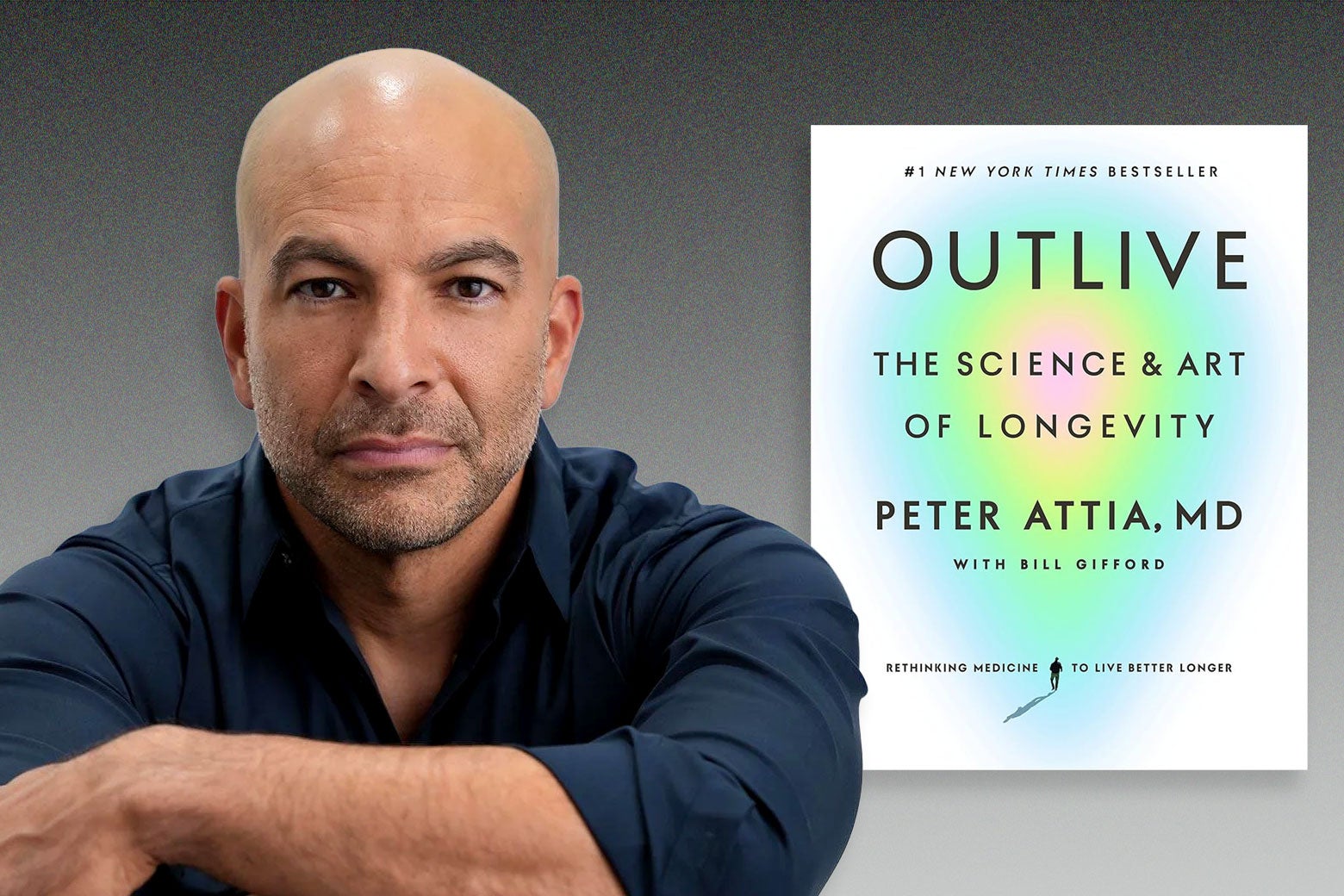
Some longevity influencers attract rubbernecking for their quixotic quests to live forever, epitomized by venture capitalist Bryan Johnson’s vampiric infusions of his teenage son’s blood plasma. Peter Attia seems, in contrast, rather sensible. There’s the fact that he went to medical school and practices as a doctor. His work has popularized the term healthspan—the years of one’s life when physical and mental abilities are still sharp, before disability or disease settles in—and the goal to maximize this period. His 2023 book Outlive: The Science and Art of Longevity, co-authored with science writer Bill Gifford, has reportedly sold more than 3 million copies. Freakonomics author Steven D. Levitt called it “one of the most important books you’ll ever read.” If you haven’t spotted Outlive on a friend’s coffee table or picked up a copy at an airport bookstore, you’ve likely encountered Attia’s thoughts somewhere like Scientific American or the New York Times, for which he headlined a health and wellness festival last spring, or via a 60 Minutes profile last fall.
Attia was, in fact, set to be a regular presence on CBS News. In late January, Bari Weiss, the division’s controversial new editor in chief, named him as part of a slate of new contributors that included controversial podcaster and neuroscientist Andrew Huberman and conservative commentators such as Niall Ferguson. Three days later, Attia’s name showed up more than 1,700 times in the latest drop of the Epstein files. Amid their yearslong email correspondence was a missive from Attia assuring Epstein, “Pussy is, indeed, low carb.” As of Monday, Attia is out at CBS News. A spokesperson for Attia told the Times that “he stepped back to ensure his involvement didn’t become a distraction from the important work being done at CBS.” Earlier in February, Attia posted a public note that read in part: “I apologize and regret putting myself in a position where emails, some of them embarrassing, tasteless, and indefensible, are now public, and that is on me.”
The Epstein of it all aside, it’s worth asking, as some doctors are: Is his body of work worth engaging with? Outlive, which spent 131 weeks on the New York Times hardcover nonfiction bestseller list, has allowed Attia to evangelize widely about how to “extend your lifespan by a decade and your healthspan possibly by two,” as he puts it, via a research-backed plan that revolves around frequent and extensive medical testing and optimizing exercise, diet, sleep, and emotional health. But what I found when I dug into the nearly 500-page tome is that we never should have listened to Attia in the first place.
Attia first gained attention in 2013 for a talk he gave at a TEDMED conference positing that metabolic dysfunction is to blame for obesity, and not the other way around. The next year, he opened Attia Medical, a concierge preventive medicine practice; in 2016, he rebranded to Early Medical, a name that emphasizes the practice’s focus on maintaining healthspan and increasing lifespan. Early Medical reportedly charges annual fees in the six figures and boasts a “low patient-to-physician ratio”; it is not currently accepting new patients. In the mid-2010s, Attia started appearing on fitness and investing podcasts to hype longevity, and in 2018, he made his first appearance on The Joe Rogan Experience—the YouTube video has more than 3 million views. Attia’s MD credential appears on the cover of Outlive, but the book does not draw much on the traditional medical training that he did receive. He graduated from Stanford University School of Medicine in 2001, but he dropped out of his general surgery residency at Johns Hopkins Hospital in 2006, two years shy of completion. In Outlive, he describes being frustrated by training geared toward fixing acute problems and managing chronic ones rather than preventing them, which makes one wonder why he chose to pursue surgery in the first place rather than, say, primary care.
After dropping out of residency, Attia worked as a credit risk consultant for McKinsey & Company, and later at an energy company, as a profile of him in the New Yorker notes. In Outlive, he recalls realizing in his mid-30s that he was on the path to insulin resistance and cardiovascular disease and, after hacking his own health, decided to return to medicine with the goal of helping patients delay or avoid death by what he calls “the Four Horsemen” of chronic disease: metabolic dysfunction, heart disease, cancer, and neurodegenerative disorders like Alzheimer’s. He is not board certified in any medical specialty, according to the Times, and as far as I can tell, he has no formal education or research experience in nutrition, metabolic health, cardiology, or neurology. Attia did spend four months of medical school working in a lab at the National Cancer Institute and returned there as a research fellow for two years during his residency. His more recent “research” appears to consist of reading studies under the tutelage of “leading experts” whom he calls his “mentors” or “gurus.”
Throughout Outlive, Attia exploits real dissatisfaction and disillusionment with “mainstream medicine,” which he refers to as “Medicine 2.0,” in order to hype “Medicine 3.0,” which he practices at Early Medical. He bases his critiques of “Medicine 2.0” on his limited experience practicing as a surgical resident and on a historical overview that, even for a pop science book, is dramatically compressed. The book implies that “Medicine 2.0” has barely made any meaningful progress since the advent of antibiotics in the early 20th century. His pièce de résistance here is a graph from economist Robert J. Gordon’s 2016 book The Rise and Fall of American Growth, which, according to Attia, illustrates that the mortality rate per 100,000 people “declined relatively little over the course of the twentieth century” if you “subtract out deaths from the eight top infectious diseases,” with the implication that “Medicine 2.0 has made scant progress against the Horsemen.” This manages to both downplay the role of public health, vaccines, and antibiotics in expanding lifespans and ignore the fact that the Horsemen—especially cancer and neurodegenerative diseases—are ailments of aging. Many people simply weren’t living long enough to die of those diseases before the 1930s because the “top infectious diseases” were so incredibly efficient at—to put it in the terms of Attia’s book—shortening both healthspans and lifespans. And Attia regularly contradicts himself about the value of “mainstream” medicine, maintaining that as a surgical resident, he was “trained to solve the problems of an earlier era: the acute illnesses and injuries that Medicine 2.0 had evolved to treat,” while also offering anecdotes about being mentored by Steven Rosenberg at the National Cancer Institute and praising Rosenberg’s research into immunotherapy. (This approach has, I think it’s worth pointing out, revolutionized treatment for several cancers, Medicine 2.0–style.)
Alongside his assertions that the goal of “mainstream” medicine is merely to “patch people up and get them out the door,” Attia writes about the Horsemen in apocalyptic terms, implying that the majority of us are already well on the path to developing these diseases. He writes that “about 90 percent of the US population” has “at least one” of five markers of metabolic syndrome, which include high blood pressure, high triglycerides, and elevated fasting glucose. Metabolic syndrome is indeed serious—the American Heart Association describes it as a “health condition that puts people at higher risk of heart disease, diabetes, stroke and diseases related to fatty buildups in artery walls (atherosclerosis).” The most widely accepted “Medicine 2.0” diagnostic threshold for this syndrome is exhibiting at least three markers; “Medicine 3.0” demands beginning interventions and treatments when patients have just one. In other words, according to Attia, nearly all American adults should be screened and treated for metabolic syndrome. Luckily, Attia claims, “changing how we exercise, what we eat, and how we sleep”—that is, following the regimen Outlive sells—“can completely turn the tables in our favor.” Though Attia writes as if mainstream medicine ignores the role of prevention, mainstream medicine already emphasizes the importance of lifestyle choices like eating well and exercising in reducing one’s risk for developing metabolic syndrome—and for treating it. But Outlive repeatedly ups the ante, taking surveillance and lifestyle interventions to the extreme.
Indeed, Outlive hypes that readers can exercise control over their bodies to the extent that they can avoid dying of the Horsemen, effectively warding off not just premature death but death that arrives right on time. Backing up his preventive prescriptions are unorthodox theories on how these diseases develop in the first place. For instance, in his chapter on cancer—astonishingly framed by an epigraph by Margaret Thatcher—Attia suggests that the unique metabolism of cancer cells, which require much more glucose than regular cells, means that there is a “link between cancer and metabolic dysfunction.” This is despite the fact that researchers have still not come to a consensus on whether the metabolism of cancer cells is a cause or symptom, or even a key feature of the disease. And while there exists a drug that exploits an enzyme pathway involved in glucose uptake, it is used for only one kind of cancer—chronic lymphocytic leukemia. Attia makes the jump between the existence of this pathway and its ability to be exploited in one kind of cancer to boldly claim, “This in turn suggests that metabolic therapies, including dietary manipulations that lower insulin levels, could potentially help slow the growth of some cancers and reduce cancer risk.” Again, this assertion, which is scant on evidence, feeds into Attia’s pet “root” cause, and his larger preventive plan.
More unorthodox still is Attia’s rhapsodic ode to rapamycin, a drug derived from an antifungal agent first discovered in the soil of a volcanic crater on Easter Island. Rapamycin, which, Attia writes, “tends to slow down the process of cellular growth and division,” is approved for use as an immunosuppressive to prevent organ rejection in patients who have had kidney transplants, but Attia believes that it “may have potential as a longevity-enhancing drug.” He’s such a fan that he has taken it himself “for its geroprotective effects” and prescribed it off-label to his patients; he also discloses that he has funded animal research into its antiaging properties. (Given that we are merely at the stage of animal research with this drug, what is the point of suggesting that it be taken so broadly?)
In addition to being prescribed “longevity” drugs that haven’t been proved to enhance longevity in humans, Attia’s patients undergo extreme amounts of medical testing surveillance to detect early signs of the Horsemen, which he describes in Outlive and promotes to readers of the book. On top of extensive blood tests searching for signals in the noise of biomarkers, Attia advises that otherwise healthy people get annual DEXA scans to measure bone density, lean body mass, and body fat; genetic testing for mutations associated with cancers and neurodegenerative diseases; CT angiograms to detect soft and calcified plaques in the coronary arteries; and other tests it’s unlikely that insurance would cover. He also promotes the controversial use of continuous glucose monitoring for people with no signs of insulin resistance; in a footnote, he discloses that in 2021 he was a paid adviser to Dexcom, which sells CGMs. He constantly minimizes the cost of all this testing; at one point he writes, “CGM costs about $120 a month, which is not insignificant—but I would argue that even this is still far cheaper than allowing someone to slide into metabolic dysfunction and eventually type 2 diabetes,” as though this is a foregone conclusion. It is not. And Attia largely downplays the risks of overtesting, which can lead to both false positives and the detection of markers that will never develop into life-threatening disease. Even early cancer screenings, which might seem uncontroversial, could lead to unnecessary treatment and not improve a patient’s outcome.
At the core of Outlive is a set of outright comical assumptions about the amount of time and money that Americans have access to. While Attia’s writing bills itself as broadly accessible, his recommendations are relevant almost exclusively to the very wealthiest among us. Perhaps this is best illustrated by the book’s seemingly benign advice: He promotes an exercise regimen consisting of three different kinds of training over at least 10 hours a week. (Only half of Americans currently meet the federal physical-activity guidelines for 150 minutes of weekly aerobic exercise; it cannot just be that we are lazy.) His chapter on sleep assumes that people aren’t getting enough of it because we have an “addiction to chronic sleep deprivation” and enjoy staying up all night, not because our schedules and stressors keep us from quality rest. In a brief final chapter that belatedly acknowledges the importance of attending to mental and emotional health to make an extended lifespan worthwhile, Attia reveals that he surrounds himself primarily with absurdly wealthy people in an anecdote about seeking “quick fixes”: “Too often I see people tethering their hopes of transformation solely to a ketamine trip or a journey to the jungles of Peru with a shaman to guide them through the mind-blowing experience of an ayahuasca journey,” he writes.
Yet—tragically—Attia has experience with the kind of hardship that can genuinely make life very difficult to live. In that same chapter, he writes about attending two different residential treatment facilities and undergoing extensive therapy to control his anger, which he discloses stems from being a victim of childhood sexual abuse. But even in this most personal part of the book, Attia fails to connect his experience with the struggles that many Americans face. Although he writes that learning to “reframe” situations by reflecting on how they look through other people’s eyes has improved his relationships, Attia does not appear to have used that perspective-shifting skill to consider the barriers many encounter when seeking support and treatment for emotional and mental health. Outlive does not touch on the difficulty many people face in finding therapists who accept insurance, and Attia does not grapple with his privilege in accessing and paying for two stints of residential treatment, as well as working with three different therapists. It is this access to care that surely affects “healthspan” too.
In a way, it’s apt that Outlive—which overlooks the social determinants of health and the role that public health has played in extending the average American’s lifespan in favor of individual “tactics”—has been so popular over the past three years. We are living in a time when the Department of Health and Human Services is led by a man who believes in miasma theory, positing that individual lifestyle choices alone can boost the immune system and protect one’s health.
I’m skeptical that the prescriptions in Outlive are truly effective at increasing “healthspan” and lifespan for anyone. But I know they’re for sure useless if you die of a vaccine-preventable disease or develop cancer from living in a place with extreme industrial pollution like Louisiana’s Cancer Alley. Still, at a time when the current Trump administration has gutted the public health apparatus and massively disinvested in quality scientific research—including into what Attia acknowledges is the most intractable of the Horsemen, cancer—Outlive promises an escape hatch. The rest of us might die even sooner, but if you have enough money—if you hobnob with the right people, have access to the right doctors, gloss over the morally bankrupt aspects of extreme wealth—you can soothe yourself by living inside an illusion.