This is Executive Dysfunction, a newsletter that highlights one under-the-radar story about how Trump is changing the law—or how the law is pushing back—and keeps you posted on the latest from Slate’s Jurisprudence team. Click here to receive it in your inbox each week.
This week, the Supreme Court effectively shielded the nation’s law enforcement from consequences when it treats journalism as a crime. In rejecting an appeal in Villarreal v. Alaniz, the court has allowed local officials in Texas to remain immune from prosecution for arresting a journalist who published information she received from a government official. This case presented a strikingly simple question: Does it violate a journalist’s First Amendment rights if they are arrested for requesting and publishing information that a government employee willingly hands over? A lower court split sharply over the answer, but this Supreme Court, given the opportunity to weigh in to help settle the law and protect the freedom of the press all over the country, decided that the best answer was no answer at all, refusing to take up the case. In response, a single justice, Sonia Sotomayor, wrote a scathing critique of the court’s decision to abstain and of the 5th U.S. Circuit Court of Appeals’ atrocious ruling protecting local police who had clearly trampled over a journalist’s First Amendment rights by arresting her.
The case of Villarreal v. Alaniz has been ping-ponging through the courts since 2019, when it was first filed by Priscilla Villarreal. She is a citizen journalist based in Laredo, in south Texas, and is considered a muckraker, a 10th grade dropout who became a journalist to cover the ins and outs of the southern border, which is a focal point of her community. Her tactics were unconventional, often including livestreaming the news from her pickup truck to a now-defunct Facebook page as it was happening. In a town of roughly 260,000, her “news on the move” operation garnered about 100,000 followers. In 2019 the New York Times declared Villarreal “the most influential journalist in Laredo.”
Things took a sharp turn for her in 2017, when she was arrested at her home for allegedly violating section 39.06(c) of the Texas Penal Code. The obscure law bans a person from soliciting or receiving nonpublic information from a public servant by means of their office or employment with the intent to obtain a benefit. It had been enacted 23 years earlier and had never once been enforced, presumably because officials recognized that it would violate all sorts of First Amendment protections, perhaps most notably the freedom of the press. Yet Laredo officials used it against Villarreal when, six months before her arrest, she texted a source she had developed within the Laredo Police Department to confirm the names of the victims in two separate incidents, a suicide and car accident. City officials argued that she received a “benefit” from this exchange of information—an increase in popularity on Facebook.
Villarreal was released on bond, and a judge dismissed her charges, declaring the Texas statute unconstitutionally vague. However, Villarreal fought back with a lawsuit demanding damages. She alleged that all the Laredo officials involved in her arrest had violated her First Amendment rights and were retaliating against her over her earlier reporting. The case spent years locked in court battles, with a district court judge first dismissing the case by claiming that the officials involved had qualified immunity, a doctrine created by the Supreme Court some 60 years ago that grants federal officials immunity from being sued under many circumstances. Eventually, the suit reached the notorious 5th U.S. Circuit Court of Appeals, and in 2022 a three-judge panel ruled in Villarreal’s favor.
But when Laredo officials appealed to have the case heard en banc by the full panel of judges, it ruled 9–6 that there was no “obvious unconstitutionality” to what had happened to her. Judge James Ho, who ruled for Villarreal on the original panel, dissented from the majority. He argued that if Villarreal’s case “is not an obvious violation of the Constitution, it’s hard to imagine what would be.” Ho is easily one of the most ultraconservative judges on the 5th Circuit, appointed by Donald Trump and infamous for his firebrand rhetoric against abortion, gun control, and vaccine mandates. As Slate’s Mark Joseph Stern wrote in praise of Ho’s position: “It is an ominous sign of the 5th Circuit’s increasingly authoritarian jurisprudence that Ho must beg his colleagues to safeguard the most foundational guarantees of free speech.”
In 2024 Villarreal appealed to the Supreme Court, asking the justices to hear her case. On first pass, they vacated the 5th Circuit’s 9–6 ruling and told the lower court to reconsider its decision. Six months later, the circuit court came to the same conclusion, ruling against Villarreal. She then went back to the Supreme Court, hoping it would finally take up her appeal.
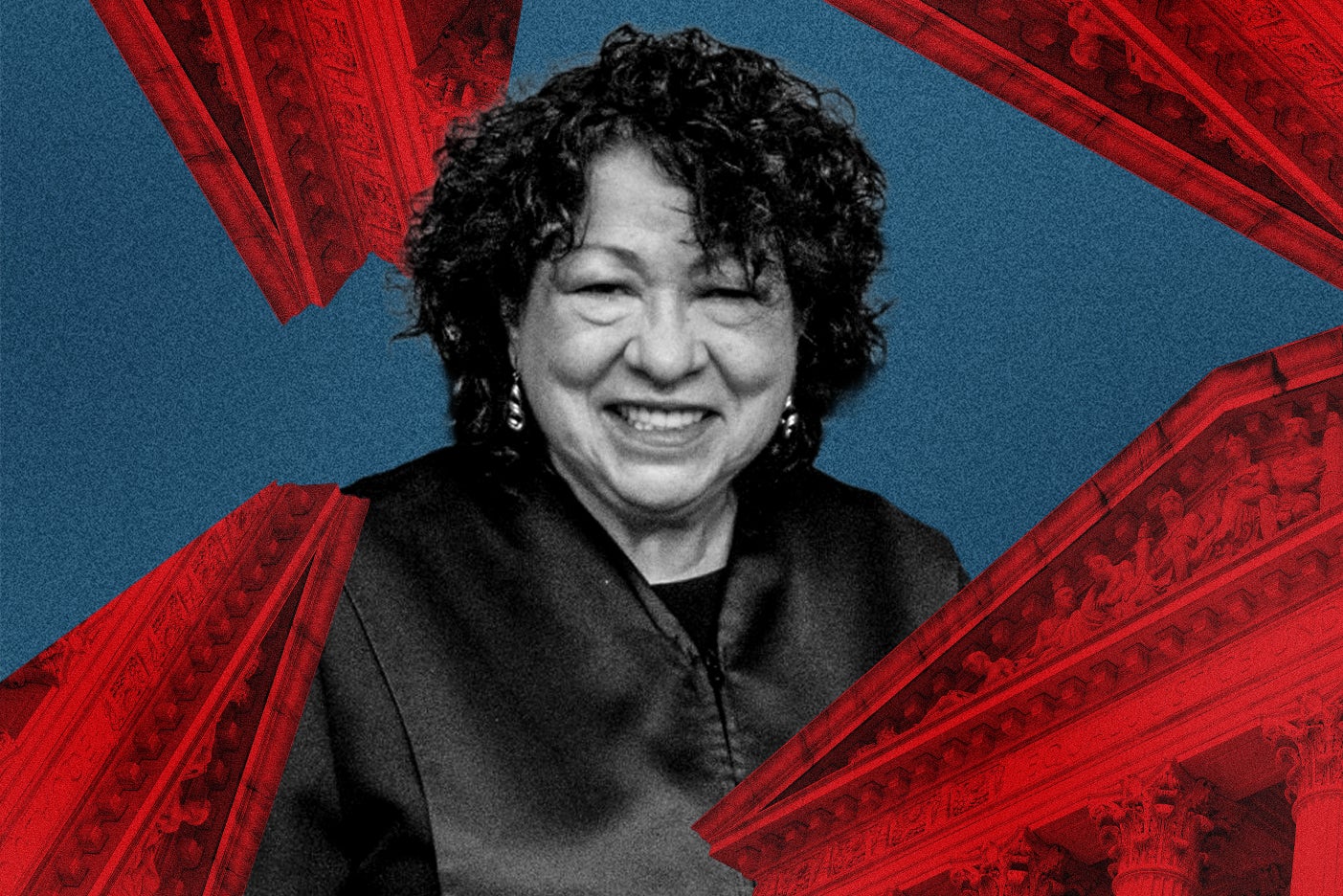
Unfortunately for Villarreal—and for journalists all over the U.S. who are constantly in communication with all kinds of government employees in exactly the same way—the court rejected her appeal with no explanation, allowing the 5th Circuit’s ruling to stand and preventing Villarreal from securing any damages for a clear abuse of her constitutional rights. Justice Sonia Sotomayor wrote a solo dissent: “It should be obvious that this arrest violated the First Amendment.”
Sotomayor methodically picked apart Laredo officials’ actions against Villarreal, as well as the Texas law they used to pin her down for simply doing her due diligence as a journalist, confirming details about a critical news story directly with the government. “By arresting Villarreal, rather than solely disciplining the employee for any wrongdoing, county officials took this ‘everyday journalism’ and transformed it ‘into a crime,’ ” she wrote. “This was a blatant First Amendment violation. No reasonable officer would have thought that he could have arrested Villarreal, consistent with the Constitution, for asking the questions she asked.”
Hiding behind the state law that seemingly legalized Villarreal’s arrest “does not and cannot insulate the officials from liability,” Sotomayor argued. She also noted that when Laredo officials had secured arrest warrants for Villarreal back in 2017, they did not disclose to the judge at the time how or why the information she had texted her police department source about was protected from disclosure. “There are good reasons to believe that it was not,” Sotomayor suggested.
As we collectively watch Trump’s second presidency play out, when he has weaponized every tool at the executive’s disposal to attack speech he does not like—Washington Post reporter Hannah Natanson, late night host Jimmy Kimmel, and a slew of major national news organizations come to mind—the Supreme Court’s lack of action threatens all Americans. Journalists have a singular ability to hold the Trump administration and local governments all across the country accountable, through shedding light on what they are doing and how they are wielding their power. Criminalizing this work without consequence doesn’t just endanger those journalists; it threatens everyday Americans who rely on local and national reporting in nearly all aspects of their lives.
Sotomayor smartly called out that the most dangerous part of the justices’ nondecision in Villarreal v. Alaniz is the message it sends to states and local law enforcement. “Under its view, police officers may arrest journalists for core First Amendment activity so long as they can point to a statute that the activity violated and that no high state court had previously invalidated, whether facially or as applied,” Sotomayor wrote. “This rule creates a perverse scheme in which officials can arrest someone for protected activity, decline to appeal a trial court’s decision declaring the statute unconstitutional (as the [Laredo] county did here), and use qualified immunity to avoid liability by citing back to that statute.”
At first glance, Villarreal may seem like a small fish, her case representing a tiny story in the larger picture of journalists all over the country covering wars, epidemics, and global economic policy. But no matter how big or small the work, journalists need to be able to seek information from government officials in order to do their jobs. This process is what led to the Pentagon Papers, and allowing it to be criminalized in the way that it was against Villarreal would make the service of journalism impossible.
We hope you learned a thing or two from this edition of Executive Dysfunction, and if you enjoyed reading it, please consider supporting our legal journalism by becoming a Slate Plus member!
Elsewhere in Jurisprudence
In the most recent episode of Amicus, Dahlia Lithwick and Mark Joseph Stern review the Supreme Court’s extraordinarily busy week, from a flurry of shadow-docket opinions to the justices’ sparring in public to the president issuing fresh threats to the justices. The duo also break down a consequential voting rights case in Watson v. Republican National Committee, its close connection to the SAVE Act, and how mail voting faces an existential challenge mere months away from the midterm elections. On Monday, the court heard the case. As Mark notes in his analysis: The court appears dangerously close to upending the 2026 midterms and potentially disenfranchising a significant number of voters.
In the Slate Plus bonus episode, Dahlia and Mark discuss an explosive hearing in New Jersey, where U.S. District Judge Zahid Quraishi threw a prosecutor out of his courtroom. The scene was incredibly rare, with Quraishi telling federal prosecutors that their office had destroyed goodwill that had taken generations to build over a hearing that was supposed to be a straightforward sentencing for a defendant who pleaded guilty to possessing child sexual abuse material. Mark explains how, despite Quraishi being a Joe Biden appointee, he is no progressive icon, having previously served as assistant chief counsel for Immigration and Customs Enforcement and as a “detention adviser” for the military during the Iraq war.
On Monday, the Department of Justice quietly caved in the aforementioned legal fight, seemingly at Quraishi’s behest, by accepting the judicial appointment of New Jersey’s U.S. attorney. Mark explains how the DOJ accepted a district court’s appointment of Robert Frazer as the new head of the state’s U.S. attorney’s office. This was a seat the Trump administration had tried to fill with Alina Habba, the president’s former personal attorney, but appears to have finally conceded. “This white flag marks the Trump administration’s biggest step back from its maximalist vision of a ‘unitary executive’ who holds total control over his entire branch,” Mark writes.
Thank you for reading Executive Dysfunction! We’re thrilled to be in your feeds and will be back with more dysfunction analysis next week.