Sign up for the Slatest to get the most insightful analysis, criticism, and advice out there, delivered to your inbox daily.
September was another brutal month for gun violence in America. Mass shootings and politically motivated violence dominated headlines. Amid the noise of outrage and panic, a quieter shift was occurring within the gun-violence prevention movement.
On Sept. 2, Everytown for Gun Safety, an organization funded by billionaire Michael Bloomberg, announced a new firearms training initiative called Train SMART. Everytown’s website describes a program “created by veterans who bring the military’s proven principles of firearms training, safety, and responsibility to the civilian market.” It promises accessible, affordable preparation for new and current gun owners who want to protect their families or to hunt and shoot recreationally.
At first glance, Train SMART may seem like a pragmatic move in a country with more than 400 million firearms distributed (unevenly) among roughly 30 percent of adults. Maybe, the thinking goes, if gun ownership isn’t going away, the next best thing is to make it safer. For decades, hard-line “gun rights” organizations have dominated many large-scale training offerings, increasingly promoting an absolutist, deregulated vision of gun ownership while largely ignoring vital principles of safety and suicide prevention. By contrast, Train SMART’s marketing emphasizes exercises on de-escalation and secure storage, topics particularly important for gun owners who are interested in self- and family defense.
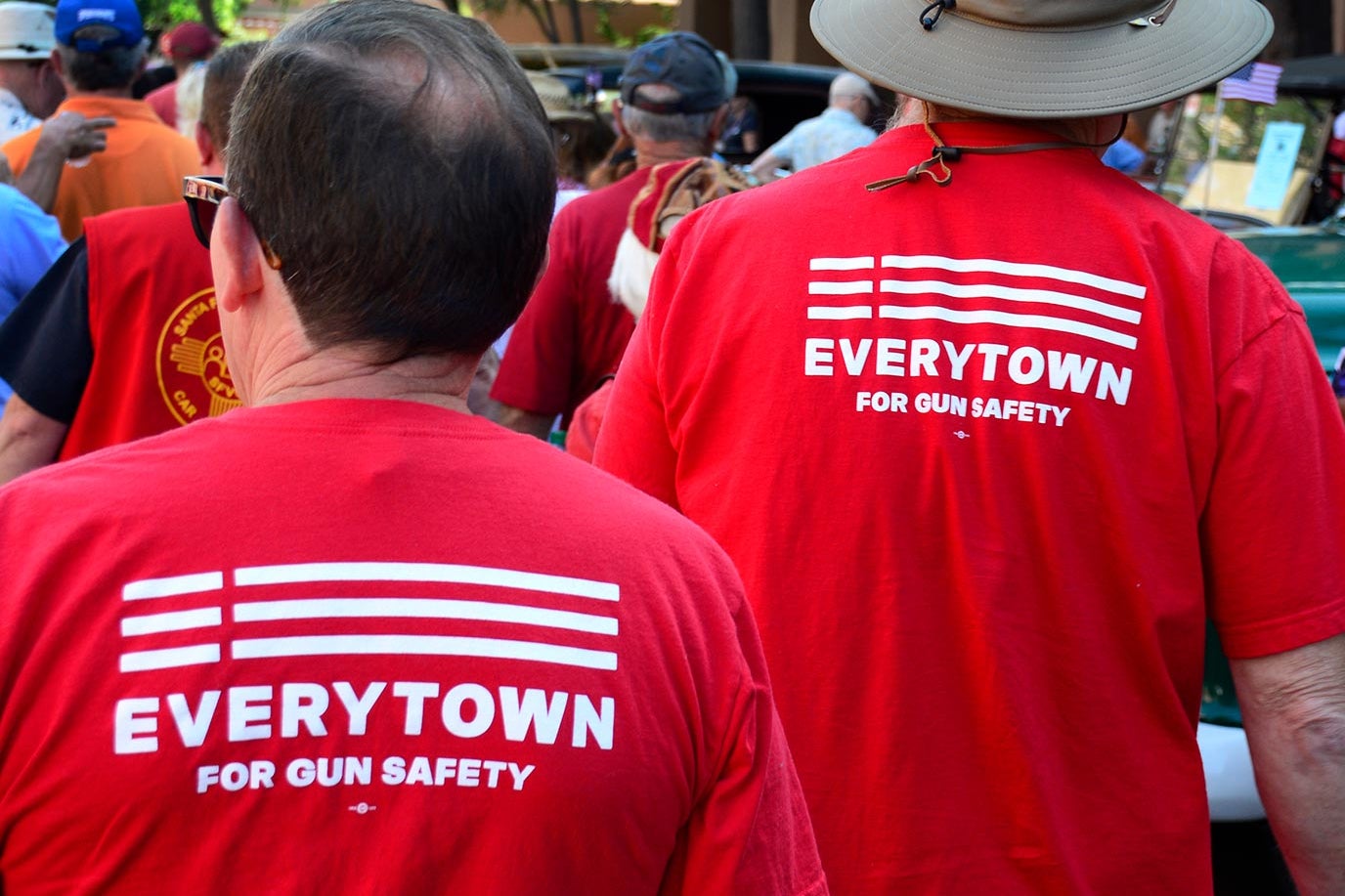
But for many of Everytown’s original supporters, especially survivors of gun violence, this move feels like a profound betrayal. Train SMART represents a major shift in focus at Everytown, founded in 2013 following the mass shooting at Sandy Hook Elementary School, in Newtown, Connecticut. Originally, the organization defined itself by a simple, evidence-based premise: Fewer guns in fewer hands means fewer deaths. Through its grassroots partners in its two major subsidiary groups, Moms Demand Action and Students Demand Action, Everytown built a massive movement grounded in public grief, unyielding advocacy, and public health–centered research. It quickly became the largest, most highly resourced organization in the effort to reduce gun violence. Its expanding network of volunteers—most of them parents, educators, and survivors—showed up in state houses and school board meetings across the country, advocating for commonsense firearm regulations designed to save lives. These voices insisted that our gun-violence epidemic could not be solved with more guns. Now these same supporters are watching the movement’s flagship organization enter the gun training business.
The launch of Train SMART signals not just a tactical pivot but a philosophical one. It suggests that Everytown has moved from a regulatory stance to one of cautious participation. Firearms training programs already exist in abundance, and many include in-depth safety instruction. This is especially true since 2020, when many people flocked to gun shops during a time of pandemic-related anxiety, economic chaos, and political polarization. Everytown presents its approach as a necessary intervention, insisting that Train SMART centers safety needs that are often missing from other programs. But in practice, this initiative blurs the once bright line between those working to prevent gun violence and those who profit—directly or indirectly—from the normalization of civilian gun ownership.
As Everytown repositions itself closer to a gun-ownership model of “responsible use,” it rejects the strong correlation between more guns and more gun deaths. Firearm injuries are the leading cause of death among children and teens in the United States. According to decades of public health research, introducing more firearms into homes, even with safety training, raises the risk of unintentional shootings, domestic violence homicides, and suicide. In fact, existing research suggests that firearm safety training does not improve secure-storage practices or reduce gun deaths.
Many of Everytown’s most committed allies are those who have experienced gun violence in their communities: parents who lost children, spouses who lost partners, students who lost friends, towns devastated by mass shootings. For them, Everytown’s pivot signals that the group believes that guns are, after all, the solution to gun violence. Andy Parker, who lost his 24-year-old daughter to a shooting that took place on live television, writes on his Substack, Andy’s Fight, that Everytown has “pour[ed] millions into weapons training programs” while treating survivors as “props” and “expendable assets.” His grief, long a catalyst for activism, has curdled into disillusionment. “It’s about whether the billions behind Everytown will ever be used to honor the dead, protect the living, and fight for the change survivors have begged for.” He concludes, “Right now, the answer is clear: they’re failing.”
Similar reactions have spread within Everytown’s ranks. Skye Thietten, a former Michigan Everytown Be SMART leader and longtime Moms Demand Action volunteer, described her initial response as one of “shock” and “deep disappointment.” After eight years with the group, she says, she will no longer “put in [the] time for an organization that supports investment of any kind in the gun industry.” For Thietten, gun-violence prevention means “educating the public on how and why guns do not make any average individual or community safer” and advocating for reforms that save lives, instead of encouraging gun ownership.
Everytown leadership markets Train SMART as a solution to decades of political gridlock on gun-violence prevention. After years of political stagnation, even under Democratic presidents, federal gun-violence prevention remains ever so rare and under attack in our current political climate. In the first few days of his administration, President Donald Trump gutted the White House Office of Gun Violence Prevention and cut grant funding allocated by the Bipartisan Safer Communities Act, the first major federal gun-reform legislation signed into law in nearly 30 years.
Deregulatory policies like permitless or “constitutional” carry and “stand your ground” laws have spread to a majority of the states, and the Trump administration threatens to adopt national reciprocity to ensure that all states abide by the lowest regulatory denominator when it comes to civilian gun carry. Given this deregulatory backdrop, Everytown’s leadership may imagine Train SMART as a way to reach gun owners where they are by emphasizing secure storage and responsibility rather than restriction. But the optics are hard to ignore. In a political climate where “gun rights” rhetoric dominates our national landscape and Republicans openly mock “gun-free zones,” Train SMART looks less like bridge building and more like appeasement. It suggests that Everytown has internalized the self-defeating logic of an increasingly mainstream “gun rights” movement: that gun ownership is inevitable, that our safety can and should be individualized, and that resistance is futile.
Above all, the shift to gun training risks alienating the very people who gave Everytown its moral authority at its founding: survivors. These were the people whose faces and personal experiences amplified the statistics, whose stories helped shift public opinion in favor of universal background checks, “red flag” laws, and secure-storage policies. For many of them, Train SMART feels like a retreat from the organization’s original focus on prevention, a signal that their grief must make room for the popular but unsupported claim that guns save lives.
The pivot to training could prove lucrative. Train SMART’s online courses range in price from $20 for a one-and-a-half-hour course on “gun safety rules, secure storage, [and] what to look for in a gun” to $100 to learn “safety and marksmanship.” In its shift toward firearm instruction, Everytown is identifying potentially profitable new markets within the very industry it was created to confront, treating gun training as both an honest cause and a source of revenue.
Sandy and Lonnie Phillips founded Survivors Empowered after Sandy’s daughter Jessi was killed in a 2012 shooting at a movie theater in Aurora, Colorado. They share a dim view of Train SMART. “If you can’t defeat your opponent,” they commented, “then you might as well work alongside them or do what they do. Nobody is doing that better than Everytown.”
Parker sees the issue in moral terms. “When a survivor stands at a podium with Everytown’s logo behind them, they believe they’re fighting for change,” he said. “But if that same logo now represents a gun training program, what does it stand for?”