Sign up for the Slatest to get the most insightful analysis, criticism, and advice out there, delivered to your inbox daily.
In preschool, I was obsessed with a costume wedding dress. I loved its big silk bow and thick tulle skirt that billowed out when I spun. I wanted to wear it everywhere. Mom was concerned. What if I turned out to be one of those girls? There are a lot of those girls where I lived in Alabama, girls whose priority is to find themselves in a wedding dress, and fast.
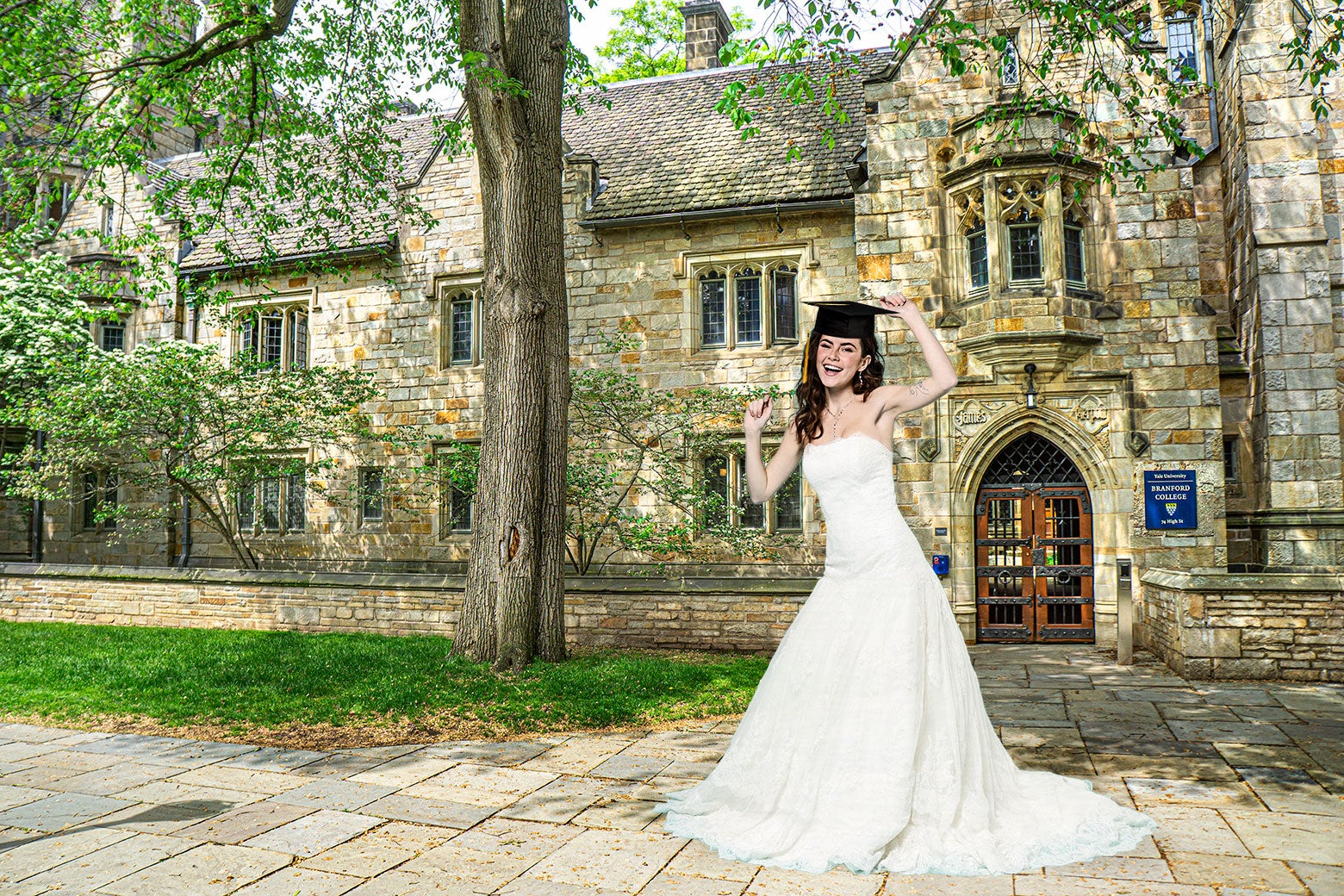
I graduate from college this spring, and my social media feeds are littered with wedding content. There are screenshots of high school friends on Facetime showing off diamond rings (sometimes, there is a man in the back corner of the frame); there are photos of calligraphied invitations and floral table settings before a bridal luncheon. I expected this from my friends in the SEC—it’s how many of us were raised. I thought Yale, where I go to college, would be different.
I imagined some of my peers in the Ivies would meet our first serious romantic partners while others sent “Hook up?” Google Calendar invites for casual sex. Those types of relationships do exist here. But I also have classmates who came back from summer vacation married. This is different from the story usually told about the Ivy League. In 2018, the New York Times reported we’re some of the least likely to get married, even after graduation, and the stereotype is that high achievers are romantically stunted. As one Columbia student tells me, “The prevailing assumption is we don’t fuck.” But Ivy Leaguers are chasing marriage with the same intensity they would approach any status symbol—high school book awards, college likely letters, six-figure jobs after graduation.
Large universities will always have students who are engaged, married, or parenting, but their numbers are on the rise. Arielle Kuperberg, a demographer and sociologist at the University of Maryland, handles a data set of more than 14,000 undergraduates across 44 colleges, including elite universities. She’s found a 33 percent increase in the number of people who are married in college since 2019. Kuperberg says my generation is more religious and socially conservative than our parents, so of course we’re marrying earlier. “We’re definitely going to see this trend increasing,” she says.
Kuperberg’s analysis holds true for my campus. Yale’s Buckley Institute, which describes itself as a “home for enlightened conservative thought,” has roughly 32 percent more active members than it did in 2022. The number of students affiliated with religious organizations or attending faith-based events has also spiked. When I ask Maytal Saltiel, Yale University’s chaplain, about an increase in the number of Yale students married before graduation, Saltiel says, “It is certainly more than” the 33 percent increase that Kuperberg found. She chalks it up to an embrace of religious institutions and traditional values, beginning with Trump’s first election. Over her 13 years at Yale, she says, previous students knew “the world was not great, but there was more optimism and hope that [it] could be.” For my class, she believes, coupling up early is an attempt at creating security amid international chaos.
MAGA is also directly pushing young straight people to marry. A newly released Heritage Foundation policy report instructs college campuses to foster a “ring by spring” culture by offering premarital education and counseling, allowing campus grounds to be used for weddings, deploying on-campus wedding photos in marriage marketing campaigns, and building married-student housing and nursing stations, among other ideas. At a 2025 leadership summit, Charlie Kirk told the “young ladies here in high school” they “should bring back the MRS degree.” He was answering a question from a first-year high school student who said she hoped to be a political journalist. She had asked Kirk about the “pros and cons” of attending college.
Sloane Huey, a senior at Yale, told me she has always planned 15 years ahead. She snagged a job offer for 2026 during her first year of college in 2022. Huey was engaged by junior year to her high school sweetheart, a Dartmouth student named Ashton Morgan. At the beginning of their relationship, they’d set dates for most milestones—when they’d be engaged (22), move into a house together (27), and try for children (28). She says, “We’ve been very purposeful with maximizing time [and] making plans. All of that is a function of personal intensity or drive.” Huey says it helps her anxiety to have a strong plan, and that successful plans require quick and decisive movement. She tells me, “What is meant to, will be,” not in a spiritual sense but “by the law of large numbers.”
She knows her single Yale friends sometimes feel competitive with her. When she tries to offer them dating advice, they’ll snap back that she got lucky with Morgan. If she mentions anything negative about her relationship, they say she can’t complain. It’s reminiscent of the conversations she had with high school friends about college after she was accepted to Yale. Her friends’ opinions on her engagement pose no worry, as Huey says, because she’s “ultimately in a better position.” (What is worrying to Huey: planning a wedding before ever attending one.)
Sabrina Zbar Kastner, a married student at Yale, brought a similar straight-A-student intensity to dating. Kastner recalls thinking, “When I start dating, I’ll get married one to two years later.” And it happened according to plan. Kastner is Orthodox Jewish, a departure from her parents, who practice a less rigid Conservative Judaism. The more religious aspects of Judaism felt authentic to her. It also provides a path: “I always know what the next step is,” says Kastner. She found Eitan Kastner at Yale, and his Orthodox thinking aligns with hers. Kastner describes the decision to get married as “practical”—the same as her reason for switching from a humanities major to molecular, cellular, and developmental biology the year prior.
Then there are married students who have already started raising children, like Hunter Wimsatt. He and his wife, Chaney Wimsatt, are devout Catholics. They got married in 2024, during their sophomore year of college. Wimsatt says he was searching for comfort and security when marriage became one of his “end goals,” and now he feels “ahead in life.” After describing his enthusiasm for traditional values, he declares, “The promises of the secular American dream have not been fulfilled.”
He’s right. Companies predict 2026 will be the worst college-graduate job market in five years as layoffs increase and artificial intelligence replaces entry-level positions. For Wimsatt, political and economic uncertainty solidified his interest in marriage. He says that it feels safer to take on the “big decisions ahead” alongside a life partner.
The University of Pennsylvania’s Amalya Knapp and MIT’s Eitan Moore married at the end of their junior years. Knapp’s high school self wouldn’t have predicted she’d marry in college, but Penn students are all “very passionate, driven, motivated people,” she says, and “that gets channeled into their personal relationships.” After being set up on their first date, Knapp and Moore flew between Boston and Philadelphia to see each other. Spending hours traveling before a relationship becomes serious may seem risky to some, but Knapp has always balanced multiple commitments, and she had already decided dating was a priority. For her, marriage is also a part of a grander search for meaning and “sense of life.”
Katrina Chorzepa, a Columbia University student engaged to classmate Santiago Hernandez, says knowing who she will marry allows her to concentrate on “genuinely getting better.” For her, this means finding a job and playing on Columbia’s soccer team. Now that Hernandez and Chorzepa have had their first child and started wedding planning, she isn’t “having to think about, ‘Oh, when I go out this weekend, I hope I find a guy that I end up with.’ ”
Her mother was initially hesitant about the relationship, telling Chorzepa it was just puppy love. But, by sophomore year, they were talking about how marriage might impact tuition. (If legally married, Chorzepa and Hernandez would appear as a no-income household on federal student aid forms, which could qualify them for maximum need-based aid.) They were already looking at rings when Chorzepa discovered she was pregnant.
The couple took a class last semester called the Science of Living Well in which at least three other couples were engaged and one married. During a unit on love and belonging, Chorzepa says she realized, “I wanted to achieve so much, but the greatest achievement I’ve ever had was to be with him and have my son. … I feel like I’ve already fulfilled my purpose.” The friends she met first year, who Chorzepa describes as “typical, ‘I want to be free and experience my sexuality, blah, blah, blah’ ” kinds of people, are now looking for serious relationships too.
There are still students like me who take electives called Monogamy and Its Discontents, where we spend class discussing the entanglement of marriage with private property and colonial civilizational narratives. Students who would never marry that guy they’re seeing, and certainly not before their first book is published. But it’s starting to feel like our numbers are dwindling. When computer science students coded a program to algorithmically pair students looking for a long-term relationship and named it Yale Marriage Pact, roughly 3,800 people signed up.
A married senior at Yale with a baby due in July, Owen Karas says not much has changed since the wedding. “I would go to the library to do homework. Now I just go home and hang out with Caroline when I do homework.” He also described marriage as his greatest achievement, one that understandably feels different than his academic or track and field accolades. “For the first time in my life, I have an achievement that lasts,” he says, “I guess I peaked?”
Karas’ question reminded me of an insight from my conversation with Saltiel. If you’re a high achiever, a person who has already decided on their faith, politics, alma mater, and career, she says, “you might as well just keep going.”
During the winter break of my sophomore year, I went back home to Alabama. Grandaddy sat me and Jack, my cousin who goes to MIT, down in the living room. He commended us for making good grades and good friends at college. But now that we had settled in, he said, we needed to start dating seriously—dating for marriage. That’s what he’d done: found Gran early, raised three children, and then shepherded seven grandchildren. It all happened at the correct times and places, and in the right order, too.