Sign up for the Slatest to get the most insightful analysis, criticism, and advice out there, delivered to your inbox daily.
In the first quarter of a recent middle school boys basketball game in eastern Kentucky, a scuffle broke out under the basket. Referees blew whistles while coaches scrambled to hold back the two players. Administrators and a local constable separated the teams and waved away parents who’d filed onto the court. The hosts of Hometown Sports Network, a streaming channel that covers Knott County games, warned that things would “get ugly” soon.
They were right. If you’ve been around interscholastic sports long enough, you can sense trouble. The real problem arrived in the fourth quarter, when two players tackled each other at half court. Coaches and teammates rushed in, and one boy appeared to kick the player from the opposing team. Security and administrators broke up the tussle, but this time parents made it to the center of the action. One man grabbed the arm of a woman—who, according to local commenters on Facebook posts, was the mother of the boy tackled. She knocked his hand away. They argued, and had to be separated themselves—until the woman’s husband ran onto the court and charged the man, pushing him backward.
Players dispersed. One of the boys who was tackled stumbled off, his face a bloody mess.
The parents were still fighting. Security managed to separate them, but the man who came to his wife’s aid wouldn’t stop. Restrained and then tackled, he got back up. A sheriff’s officer confronted him, and a moment later, the parent was shocked with a Taser and fell in a heap onto the court.
“They just tased Ryan,” one of the hosts nonchalantly observed, creating a meme that would soon be used by college teams like Vanderbilt University’s. (The host later told Kentucky Sports Radio that 25 years as a state police officer meant that nothing surprised him.) The game was canceled, and the clip was shared widely online, tagged by one local coach as “just another wild night in the mountains.”
Just another night in America. A recent high school boys basketball game in San Bernardino, California, turned into a brawl between players, coaches, parents, and fans after the winning team extended their lead to 15 in the final seconds. In Staten Island, two mothers battled during a middle school boys game: handfuls of hair, grappling and punching. When other parents tried to quell the fight, more skirmishes followed. Basketball is not the only wild winter sport; police in North Branford, Connecticut, arrested a parent and a youth ice hockey coach for fighting. According to local reports, the parent was unhappy about their child’s playing time.
Are youth sports parents getting worse? Or have they been this toxic all along?
At the start of high school sporting events here in New Jersey, a school representative reads a note on behalf of the state’s athletic association: “There will be no tolerance for any negative behavior, such as taunting, trash talking and verbal, written, or physical conduct related to race, gender, ethnicity, disability, sexual orientation, or religion. Such behavior will result in being ejected from this event.” Then the game starts, and moments after the opening kickoff or tipoff, the taunting invariably begins.
I recently watched a game between the two high school girls teams in my town, and the opening admonition to be nice was roundly ignored. The heckling between students was relentless, especially toward one player who was already committed to a Division I school. Administrators stood in front of the student section, but did little to quell their words.
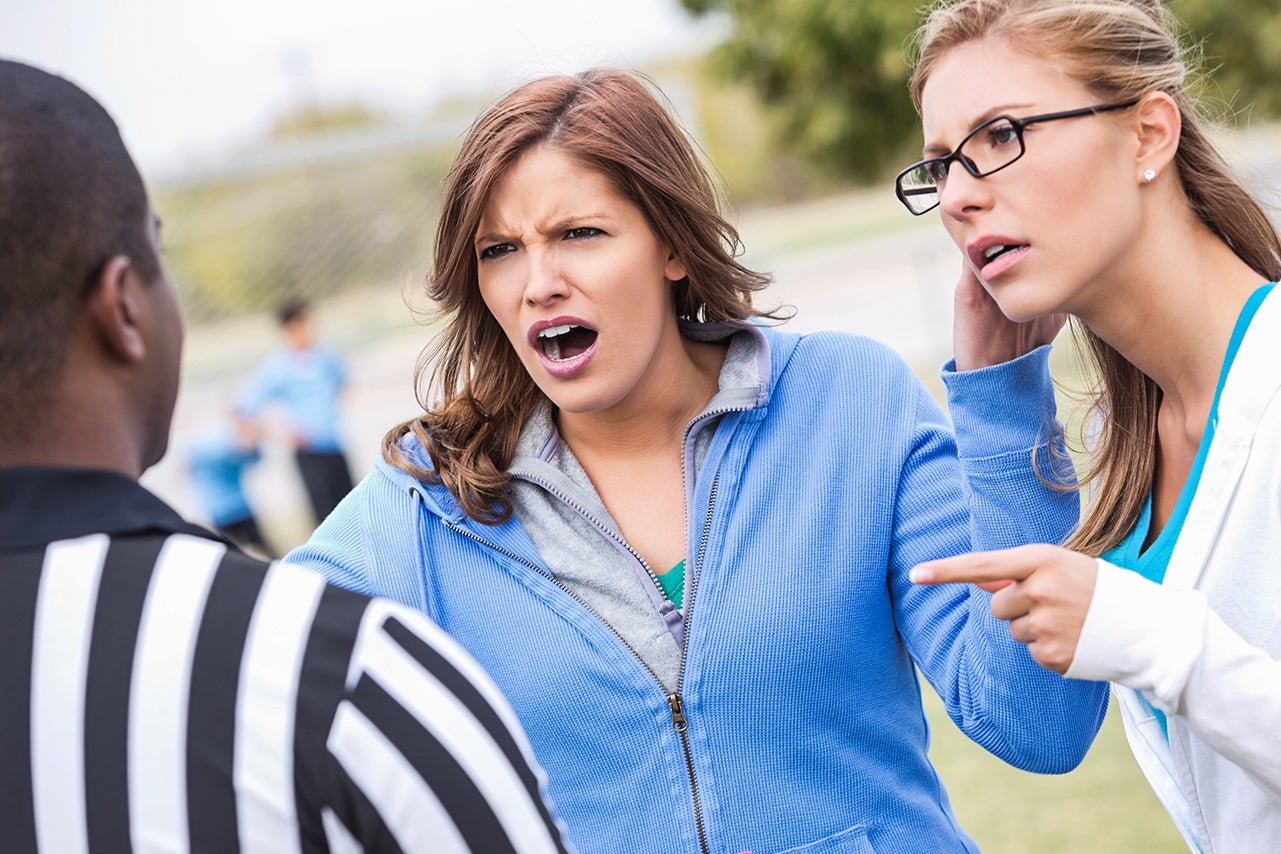
Perhaps the vocal students were acting exactly as their parents had taught them to. Go to a middle school soccer or basketball game, and you’ll hear parents harassing refs, threatening the other team’s fans, and insulting young players. I know this from experience.
My twin daughters are 12, and have long been playing competitive sports: year-round basketball, club and travel soccer, and now interscholastic contests. We’ve traveled up and down the state, into New York and Pennsylvania and elsewhere, and have gotten to the point where we can easily identify the problem parents: the ones who stand, huddled together, making their way up and down the sidelines, as if the field or court is theirs to monitor.
At another recent game, an opposing parent spread across the bottom rows of the bleachers, his purple sneakers nearly peeking over the sideline. He had been running his mouth from the initial jump ball, criticizing each call against his team, and yelling at his daughter (bad sports parents tend to be equal-opportunity offenders). During one play, his daughter was dribbling downcourt, and my daughter was playing tight defense—and the man screamed at my daughter that she couldn’t do that. He broke the cardinal rule of youth spectating: You don’t yell at a kid on the other team. And he did so not from the top row of bleachers, but from a few feet away.
The ball went out of bounds, and my daughter told the man to not talk to her. In turn, he mocked her: an infantile gesture that led to shouting between the opposing parents. (Including myself. I’m not immune to getting caught up in the moment.) Only when our school’s athletic director threatened the man with dismissal did he stop.
Harvard psychologist Richard Weissbourd senses that any increases in spectator violence and outbursts arise from a few factors. Parents, he told me over email, “are more involved in children’s games than in the past,” and they “are more likely to perceive their children’s athletic success as a ticket to a good college, amping up pressure on them and their kids.”
Most people feel like things are getting worse, he told me. But pinning down specific numbers is difficult. “It seems that many coaches are reporting an uptick in harmful parent behavior, but I don’t think there’s good national data about whether negative incidents have, in fact, increased,” Weissbourd said. His observation reflects what other experts in the field of youth sports—sociologists, professors, sport historians—that I contacted said.
Jerry Reynolds, an associate professor of social work at Ball State University, conducted a revealing study about the behaviors of parent spectators at youth sporting events. In 2019, the Louisiana state Legislature passed Act 355 to affirm as a crime and set the penalty for “harassment of a school or recreation athletic contest official,” following a rise in officials quitting due to spectator behavior. Reynolds studied spectator behavior in the state, and concluded that “the frequency at which parents are yelling at referees may imply that parents are attempting to override authoritative figures who are trained to enforce the rules of the game.” I asked him why parents—some of whom had never dribbled a basketball or soccer ball—might think they know the game better than officials.
“My hunch is that much of this is rooted in grievance culture and the transactional nature of youth sports,” he says. Youth sports carry the veneer of professionalization: expensive season fees, travel, sleek uniform kits and other merchandising, and Instagram accounts full of highlights for elementary-aged athletes. Parents, therefore, “believe that a certain product,” like “professional officiating, should be delivered at the youth-sport level. When this doesn’t align with expectations, there is divergence from viewing the referee as an authority figure.”
Stacy Warner, a professor of sport management at East Carolina University, is skeptical that fan behavior has gotten worse. (“I remind students often that some Roman gladiators fought to the death,” she said.) But she does acknowledge a paradox. Social media enables people to document bad spectator behavior. Yet having such videos “likely has also led to the perception that violence and poor parent behavior in sport is increasing as isolated incidents are amplified and widely shared.” We don’t have to watch and share videos of parents behaving badly, of course. But such avoidance makes me think of a line from Joyce Carol Oates. In a classic essay on boxing, she captured the illogic of puritanical thinking: “Ban the spectacle, and the obscenity will cease to exist.”
Jay Coakley, the executive director of the Center for Critical Sport Studies at the University of Colorado, Colorado Springs, has been studying the sociology of sport for over 50 years. According to him, spectator violence “occurs more frequently today than in the past.” Parents spend more money—that they often can’t afford to—on sports, and those expenses, coupled with investments of time, create an ideal situation for intense emotions. “Violence is most likely to occur when one or more parents feel that support for their child is being criticized by others,” Coakley says.
Although spectator treatment of referees is a real problem—a 2023 survey by the National Association of Sports Officials reported that over 68 percent of referees said that fan sportsmanship was getting worse—there’s a reasonable expectation that those in charge of a game protect the safety of players, especially in contact sports. In my own experience, a perceived bad call is often the initial spark, and parent reaction is the catalyst. Our age is known for partisan bickering and tribalism, but there’s nothing more animating than a parent’s perception that their child is being harmed and that they are powerless to help.
Back in 1947, in basketball-wild Indiana, school officials had an anodyne name for the “free-for-all fights” that seemed to be happening more and more: “spectator participation.” L.V. Phillips, then the commissioner of the state athletic association, blamed widespread betting on games, and overcrowded gyms. “If fans are forced to stand in aisles and along the edge of the court, they are too close to the players and the officials and the general discomfort puts them in a bad humor,” he told the Herald-Times. Back then—and now—maybe we just need to go for a walk and get a little air, and remember that it’s just a game.