Dear Prudence is Slate’s advice column. Submit questions here.
Dear Prudence,
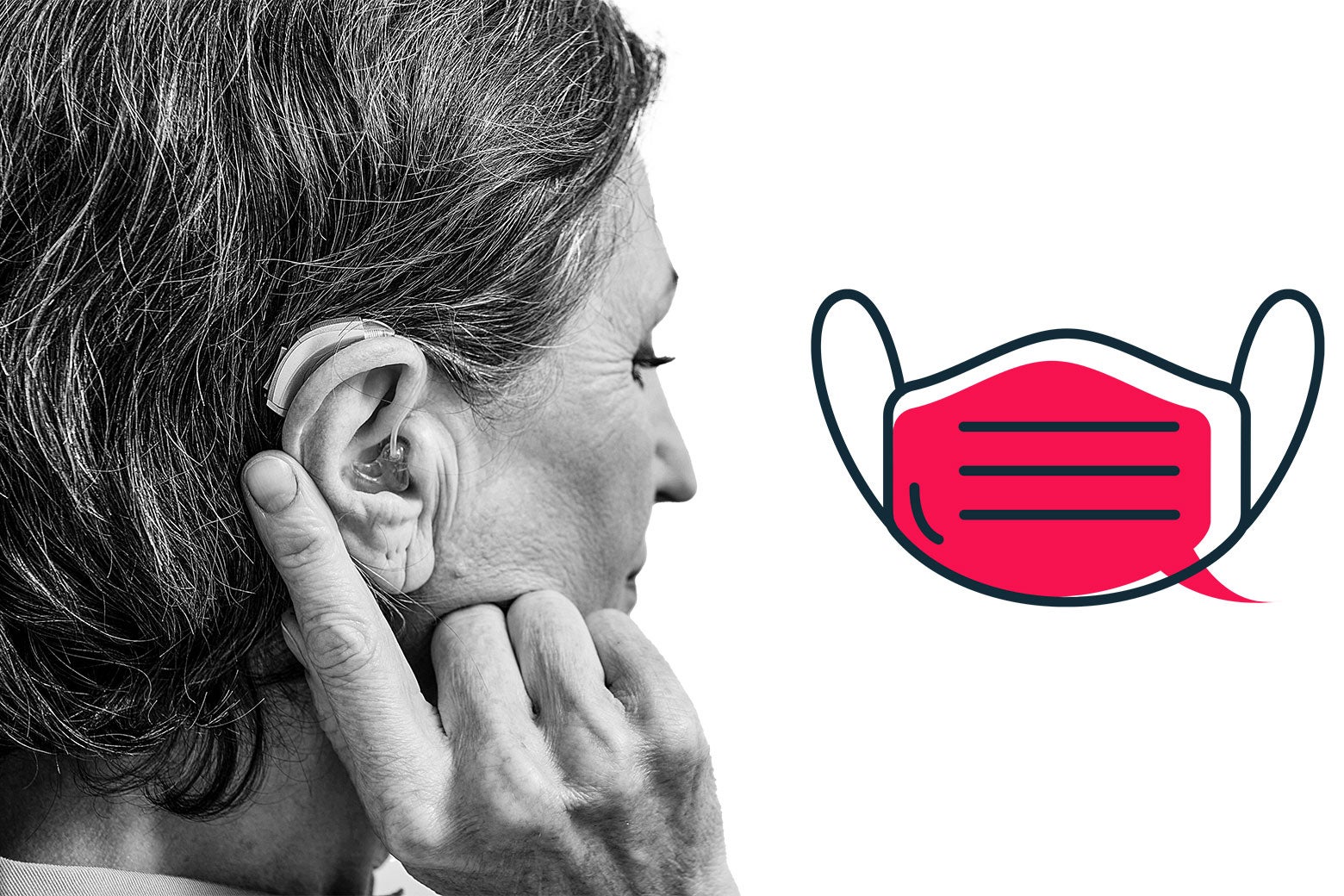
I work in a large, diverse organization. I have age-related hearing loss and wear hearing aids but nobody knows (I think) because of my own anxiety about ageism. I have to attend lots of meetings. One staff person is still wearing a mask because of their own health conditions. This is absolutely fine except for one thing: They are not a native English-speaker and have a very heavy accent. Their English is excellent but their accent makes it hard for me to understand them, even with my hearing aids, and due to the mask, I lose my ability to lip-read and get those other cues that are so important to comprehension. This is an extremely common aspect of hearing loss, the loss of the ability to understand accents. But it’s also a sensitive issue, I think.
I would like to ask them to lower their mask while they are speaking. I sit close to them, but still, it’s very difficult to hear everything they are saying and I know I’m missing some of it. There are competing priorities, both of which are valuable, her mask/health and my hearing, and I don’t know the most tactful way to approach this. Obviously, I would tell them why I am asking this if I go that route, and understand that what I believe to be my secret might cease to be that, but it’s a risk I am willing to take so that I don’t lose too much of the content. How do you recommend I proceed?
—Could You Repeat That?
Dear Repeat That,
Okay, so the competing priorities are:
—Understanding what your colleague says
—Avoiding the suggestion that their accent is a problem or suggesting that their English isn’t good
—Their need to keep their mask on and protect their health
—Your desire to keep your hearing loss private (although you’re willing to bend on this)
I think asking them to lower their mask is a non-starter. They’re wearing it for a reason and lowering it when they talk would make it ineffective. So this request would put them in a really difficult position—and could potentially lead to illness for them.
In fact, I think asking this individual colleague to do anything is the wrong approach. It might help to reframe your thinking about the issue you’re facing here. It’s not that you have this embarrassing secret and you need to figure out a way to get one of your co-workers to make adjustments to help you. It’s that you have a disability that is nothing to be ashamed of and your employer has an obligation to accommodate you and make it possible for you to do your job. If it helps, remember that this is bigger than you—any changes you push for will make your workplace an easier place for anyone else with hearing loss to work. So go to one trusted manager or human resources. Explain that you prefer to keep your hearing loss private, but need to work with them to figure out how you get fully participate in meetings when some colleagues may be harder to hear. You might mention the mask as something that is making things especially challenging for you, but I wouldn’t focus on that exclusively. After all, you need a solution that will help if someone else mumbles, faces away from you when they speak, puts a hand over their mouth, or calls in using Zoom and you don’t have a clear view of their face on the screen. It’s really not about this one person’s face covering—this likely won’t be the last situation you need help navigating.
There’s a lot of technology that can help with this—for example, many workplaces use closed captioning in virtual meetings. And a very easy, low-tech start would be for your team to assign a note-taker to quickly summarize what each speaker says and write a key. In this day and age, most employers do try to be as inclusive as possible, so I don’t think this request will be unwelcome. Remember, whoever is in charge there wants you, your masked colleague, and everyone else to have what you need to do the work they hired you for.
Help! I Don’t Want My Dad to Attend My Daughter’s Wedding.
The Dear Prudence podcast is back. Listen every Friday on Slate or your podcast player of choice.
Dear Prudence,
My father (who passed away five years ago) and I (32F) didn’t have much of a relationship. My older siblings had very traditional, caring dynamics with him. There is a large age gap between them and me, so the best I’ve ever been able to figure out is that he didn’t want to repeat the early stages of fatherhood for me. My mother also has some excuses about how there was medical trauma for both of us when I was born and my father was triggered by hospitals after some bad experiences, so he never really let himself bond with me. They divorced in my late teens. In the years between the divorce and his death, I generally saw him two to three times a year at various holiday gatherings hosted by my siblings and we either didn’t interact or made general small talk.
Since his death, my siblings hold a memorial on his death date and recognize his birthday at a holiday celebration (his birthday was on the holiday). I generally don’t make an effort to attend the memorial, especially because it’s in a busy season for me at work, but am at the holiday gathering and go along with whatever they do. This year after the memorial, my sister called me very upset that I never participated and told me it “would mean so much to Dad to know we were remembering him” and that “he was my father too, even if I’m trying to forget that.” I told her she was correct, he was my father, but there’s a big difference between being a father and being a dad. I told her that I understand and respect her need to remember him differently than I do and asked that she do the same for me. She told me I’m being dramatic and that he was dead, the least I could do is show him some love and respect. I ended the phone call, recognizing she was hurt and not going to understand things from my perspective. But we have a big family event coming up that she and I always coordinate all the food for, so I need to work closely with her and I know she will still be sulky. Any tips on how to approach this with her?
—Had a Father, Not a Dad
Dear Not a Dad,
Just remember that she can be sulky and you don’t have to do a single thing in response to her feelings. You’ve explained where you’re coming from. That’s enough—you don’t owe her anything else.
Also, if her relationship with him was really as fantastic and rewarding as she describes, I don’t think she’d be so focused on demanding love and respect from other people for him or keeping up appearances for many years after his death. I feel like she’s trying to compensate for something here. But that’s not for you to get to the bottom of or worry about.
How to Get Advice From Prudie
Submit your questions anonymously here. (Questions may be edited for publication.) Join the live chat every Monday at noon (and submit your comments) here.
Dear Prudence,
My girlfriend is brilliant, both in her grasp of new skills or ideas generally, but also professionally. She is a researcher in a complex technical field and received her undergraduate and PhD degrees from Harvard and MIT, respectively. She’s really proud of her work but also has complicated feelings about her alma maters. She grew up in a blue-collar household, and her parents pushed her not to go to college, but she made it anyway. Once there, she had mixed experiences—she was successful and happy academically but felt the class and money differences incredibly strongly, and believes that most people she went to school with are “entitled idiots with too much money” (in her words).
She felt very alone and was frustrated by cliquey behavior. In her current job, most of her colleagues went to Ivy Leagues, but she feels very welcome and at home because everyone is obsessively focused on the work. My parents are middle class and very invested in signifiers like the right college, a prestigious job, or a name drop. Whenever they introduce her to family or friends, or when we visit, they always describe her as “Harvard educated” and emphasize her prestigious accomplishments. I’m glad they’re proud of how smart and hardworking she is—I’m proud too! But it makes her really uncomfortable, especially because she wants to basically reject the exact class signifiers they’re aspiring to for her, and I’d like to ask them to tone it down. How do I do that?
—Trying to Make It Easier
Dear Trying to Make It Easier,
“Hey Mom and Dad, I’m so glad you like Girlfriend and appreciate her amazing educational accomplishments. But as I get to know her better, I realize she doesn’t like to make a big deal of the schools she went to. Do you mind leaving it out when you introduce her to people in the future?”
Dear Prudence,
I’ve been with a wonderful woman for three years. We got engaged, she got pregnant, and we were planning a happy future together. But then many things happened in quick succession and now I’m left feeling adrift: Her father died from cancer, then she got into a car accident and had a miscarriage. The happy, bubbly person I fell in love with turned into an angry, bitter woman who lashes out at everyone and picks fights at the smallest provocation. I try my best to support her, but I’m feeling burned out and taken for granted. I understand she’s hurt and grieving, but I feel that it isn’t an excuse to scream and yell at someone just for breathing. I’m considering breaking off the engagement, but at the same time we’ve been together for three years, and up until recently, we were happy together. The other issue is that we moved in together shortly before our engagement, and we had just renewed our lease for another year. But every day I spend with her is crushing me, to the point where I dread coming home. Is it abandoning her if I break up with her?
—Sunk Cost
Dear Sunk Cost,
The only thing worse than being abandoned after a series of tragedies would be being married to a man who no longer loves the person you are after a series of tragedies. You aren’t doing her any favors by staying with her if you no longer like who she is. You should break up.
Dear Prudence,
I had a good friend, “Dave,” who lost his wife about 10 years ago. On the anniversary of her death, he posts a remembrance on Facebook, which is fine. Everyone experiences grief in different ways. What bothers me is Dave cannot seem to move on in his life. He has lots of friends and a great but stressful job and is generally a people-pleaser. Over the years, he has expressed to me how lonely he is and how much he misses his wife to the point of trying to manipulate me to feel sorry for him after endless talks and tears about his life. I also think he hits the booze and pot just a bit too much. He said he has gone to counseling, but I could not see any evidence of it. He talks a lot and doesn’t listen, plays the victim, and has crossed boundaries numerous times, plus he can’t take “no” for an answer. The bottom line: I lost patience with him after several years of this. It got to the point that for my own sanity, I had to distance myself from him and block him on my phone because he would not stop texting me after I made it clear that I was no longer engaged in our friendship. I feel terrible about this, but I saw no other way out. I don’t miss him, so why do I feel bad about walking away?
—Grieving Former Friend
Dear Former Friend,
You probably feel bad about walking away because you got mad at your friend for going through the worst struggle of his lifetime and failing to grieve on your timeline. You were right to back off if you were out of sympathy for him and couldn’t excuse his behavior any longer. But that’s ultimately, why you feel guilty.
Classic Prudie
Last year, I lent my brother an expensive piece of photography equipment. After a few months, his wife sold it on eBay; I didn’t find out about it until I asked for it back for a project. He apologized and said it was an accident (she thought the equipment was his). He offered to buy a replacement, but I said there was no need. Fast forward a year later, my brother asked me to borrow another piece of equipment…