In the first chapter of Serena Kutchinsky’s captivating new memoir, Kutchinsky’s Egg, the author recalls canoodling with a man she’d just met at the 2009 Glastonbury Festival—an outdoor music and performing arts event held in Somerset, England, that still has shreds of hippie-ish idealism clinging to it. She was just off a breakup and pushing 30, but the story she beguiled this stranger with in the early hours of the morning was about her father and how he’d made the world’s largest jeweled egg. The egg ruined him, she explained: “We had this historic, hundred-year-old business and it was all going smoothly, until my dad decided to make this massive gold and diamond egg … and it … smashed everything to bits.” By 2009, neither she nor anyone she knew had any idea where the egg was.
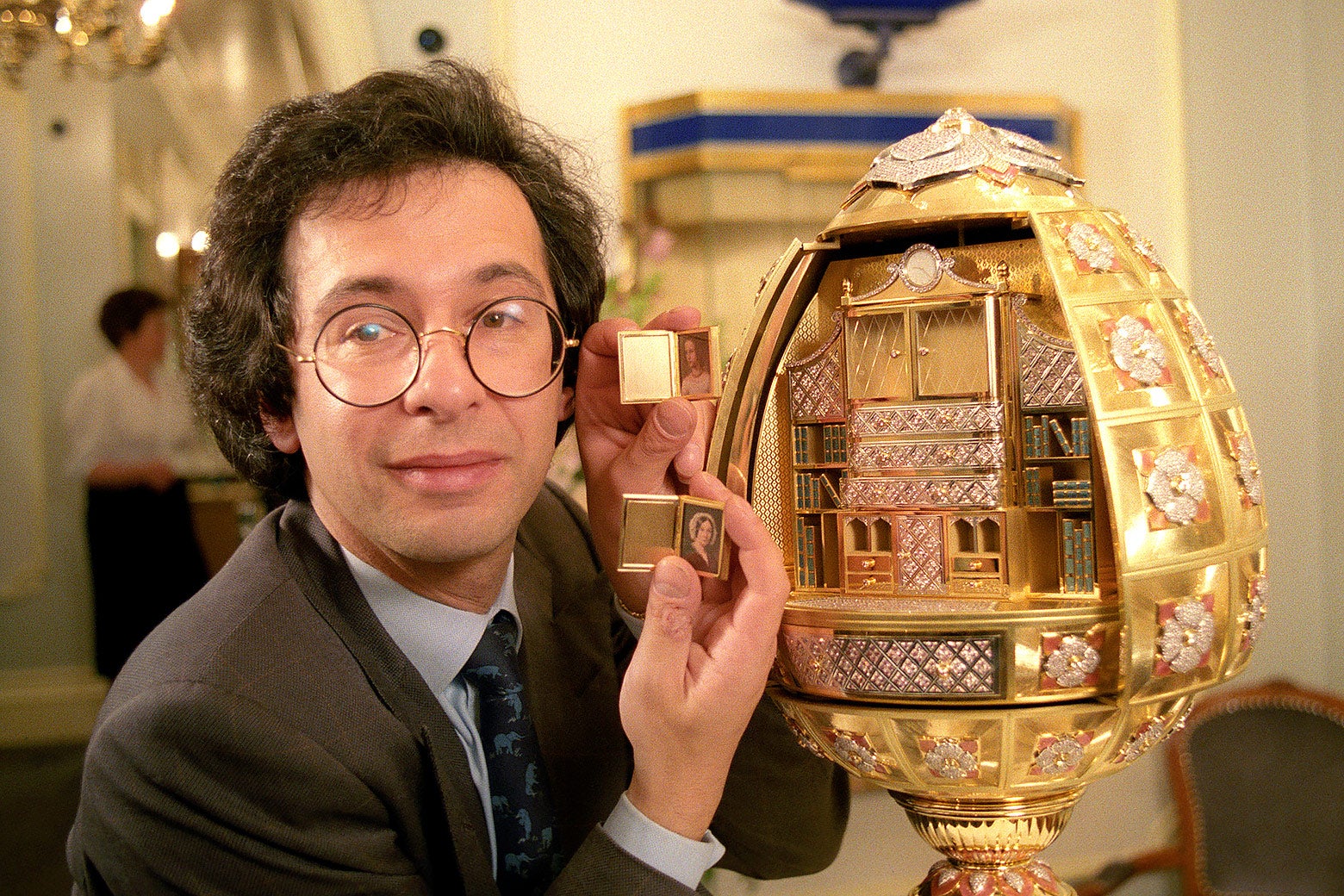
Telling stories about ourselves and our families is a time-honored form of courtship, whether we’re trying to charm a potential lover, a new friend, a customer, or, in Serena Kutchinsky’s case, readers. (She didn’t hook up with the guy at Glastonbury, but thousands of copies of Kutchinsky’s Egg will arrive in bookstores on March 31, primed to seduce just about anybody who picks one up.) She comes from a family packed with story-worthy characters, people whose innate sense of drama she has clearly inherited and spun into an irresistible saga. The egg—officially known as the Argyle Library Egg and encrusted with 24,000 pink diamonds—is a compelling object, a 2-foot-tall, 33-pound bid to rival the fabled eggs made by the legendary French jeweler Carl Fabergé for the Russian czar in the late 19th century. Still, it’s just an object, even if it is worth more than $11 million. What makes Kutchinsky’s Egg so spellbinding is not the egg but the Kutchinskys themselves.
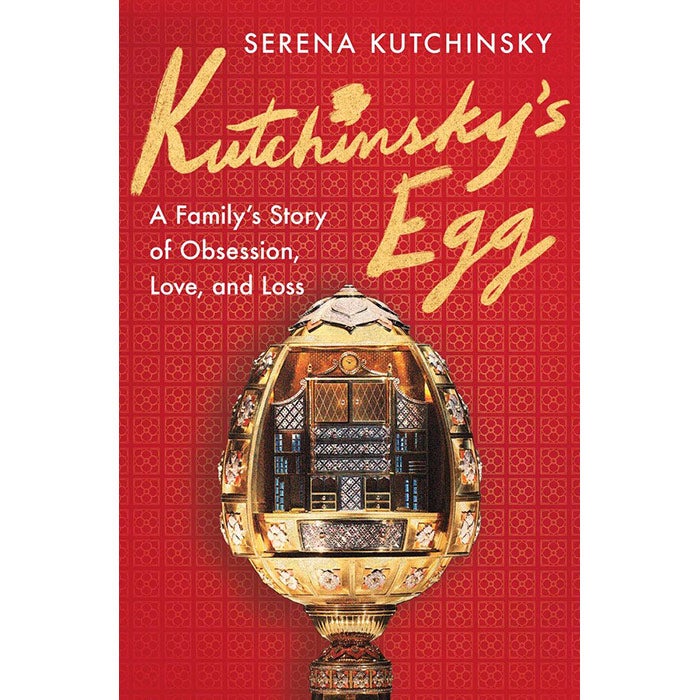
Kutchinsky’s Egg: A Family’s Story of Obsession, Love, and Loss
By Serena Kutchinsky. Scribner.
Slate receives a commission when you purchase items using the links on this page. Thank you for your support.
Serena’s great-great-grandparents fled the pogroms in Poland in the 1890s, aiming for America but getting stuck in London, probably due to a cholera epidemic that choked off immigration, though there is family lore about the couple being scammed out of their life savings. Her great-great-grandfather set up as a humble watchmaker and clock repairer in London’s East End. His son, her great-grandfather, married the daughter of a German Jewish jeweler so fancy he was an official supplier to the crown prince of Bavaria and taught his son-in-law “the art of cultivating a higher class of clientele. How to identify their exact desires before they articulated them, whether it was a necklace for a wife or mistress.” Many years later, Serena—who became a journalist—would recognize the peril in this practice, at which her father also excelled. High-end jewelers are prosperous, but their clientele is fabulously rich, and identifying with their tastes and desires can lead to a hazardous yen to live beyond one’s means.
Jo Kutchinsky, Serena’s grandfather, made the House of Kutchinsky one of Britain’s top jewelers in the 1960s. Partnering with a talented goldsmith, he favored modern, European-influenced designs that were “a riot of color and fun,” pairing “rich blue lapis, and golden-brown tigereye, and organic materials like coral, which were rarely used in fine jewelry at the time.” Their bold watches and bracelets and brooches found favor with the era’s hip young Britons and American movie stars. The Beatles bought jewelry for their girlfriends, and Zsa Zsa Gabor stopped by to load up on bling. Jo had all his suits made with a secret pocket in which he kept a loaded pistol to fend off thieves. Rumor had it he’d gotten the gun from the Kray twins, infamous gangster brothers who were his customers from way back.
Not bad for a guy who, in 1940, had spent eight months in a series of prisons and, finally, a circus elephant house that had been commandeered as an internment camp, charged with war profiteering. Jo and a pal had been selling fake epilepsy certificates to young men trying to avoid military conscription. “Jo had no moral code,” Serena writes almost blithely of her grandfather. “It’s what made him such a wily businessman. He was a liar, a swindler, and a smuggler.” His adored wife, Lily, was an imperious matriarch, who, according to Serena’s mother, did “domestic tasks like cooking and washing dishes while wearing a lilac-and-green Pucci minidress, silver kitten-heel slippers, and large diamond earrings.” Of her two sons, Lily flagrantly favored Paul—Serena’s spoiled and reckless but charming father—over the older, dutiful Roger, who resented this so much he refused to speak to his niece for the book.
Paul—whose terrible grades left him with few college options—randomly picked the University of Aberdeen, which is how he ended up engaged to Brenda Strachan, Serena’s mother, a Scottish shiksa. Lily was “incandescent with rage” and sent two of her nephews to Scotland to bribe or bully Brenda’s parents into ending the relationship. “I didn’t want to carry out her dirty work,” one of the men told Serena. “I had no choice. I was told to get on a plane to Scotland, find the Strachans, and get rid of Brenda.” Despite this ominous wording—did I mention that the Kutchinskys are dramatic?—it was a cordial visit, with Brenda’s parents inviting the emissaries in for tea and cake before explaining they had no control over the younger couple.
Serena was Paul’s favorite, just as he had been his mother’s. When she was a toddler, he dressed her in “a mini fox-fur coat, which I wore with a Parisian-style beret.” The family holidayed in the South of France and took skiing trips to Switzerland. Unlike her stolid parents, Brenda had a flair for intrigue to rival that of any stereotypical Jewish mother. She describes Paul’s business partners as her “nemesis,” adding that her husband “wouldn’t listen, he was obsessed with them. He was like a lamb to the slaughter.” She blames this pair for introducing her husband to the blonde who broke up their marriage, and also for encouraging his other obsession, the one about making the world’s largest jeweled egg.
Somewhere around the point when the craze-prone Paul sponsored a polo team that beat Prince Charles’ team in a particularly memorable match, I had half-forgotten the titular egg, despite the fact that it had motorized doors that opened up to reveal a miniature, diamond-encrusted library. That’s how diverting the Kutchinskys, with their multifarious feuds and scandals, can be. (In passing, Serena refers to an anonymous letter her mother once spotted among her father’s papers containing “a secret involving someone close to the family” that was “so grave that, even now, nobody will tell me exactly what it was.”) The story of the egg and its making is also full of artifice and betrayals, but in essence it was a massive gamble rooted in Paul’s grandiosity and fundamental misunderstanding of his own profession.
The egg garnered tons of publicity after it was completed in 1990 but attracted no purchasers, Serena learned, because the kind of people rich enough to buy something like that don’t typically want the world to know they own it. “The thing is, darling,” a former colleague of her father’s told her, “discretion is everything in our business.” Also, the timing was poor. Paul made most of his money selling jewelry and objets d’art to wealthy Middle Easterners like the sultan of Brunei, who commissioned for his children a set of jeweled golden figurines of characters from The Simpsons, a creation whose questionable copyright status was deftly finessed by the fact that no public photos of the figurines exist and hardly anyone has ever even seen them. For these customers, the first Gulf War drastically curtailed the go-go luxury spending of the 1980s.
Ultimately, the cost of making the egg and Paul’s inability to sell it bankrupted the House of Kutchinsky, and the company was sold to a rival who promptly fired Paul. The Australian diamond mining company that had supplied most of the egg’s diamonds claimed the object and stashed it in a warehouse. Eventually, a Japanese businessman bought the egg, but due to the above-mentioned discretion, Serena found it hard to identify which one. The egg had effectively disappeared. After her father died in a car crash in Spain in 2000, Serena herself became obsessed with seeing the egg again, and the final pages of Kutchinsky’s Egg are devoted to her search for it.
While the egg certainly did ruin the Kutchinsky family’s business, Paul’s survivors also blame it for the bust-up of his marriage and family. “Mum raged against it as if it were human,” Serena writes, “a Maleficent-like villain that stole her livelihood and her husband and robbed her children of a father.” The livelihood? Sure. But the loss of his marriage and family you could easily write off to something much more banal: a midlife crisis. (“He’s dick-struck,” Serena once heard her mother wailing on the phone to a friend.) But who wants to say that their childhood shattered over a middle-aged thrill-seeker’s infatuation with a much younger woman, when they can instead blame it on the world’s largest bejeweled egg? Not a Kutchinsky, that’s for sure.