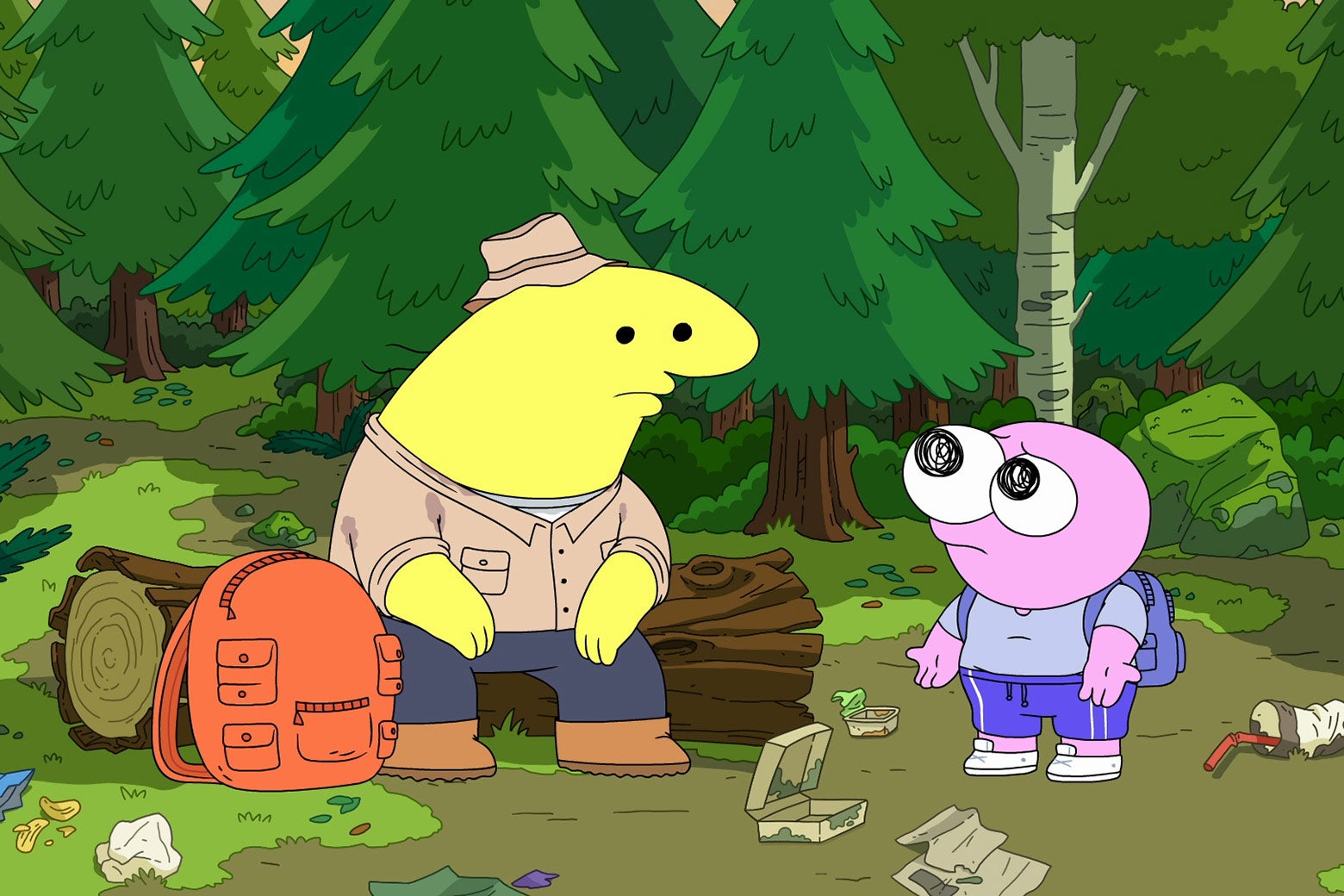
There were no warnings, no blaring push notifications, no opportunities for the fans to brace themselves. Around 10 p.m. Wednesday night, Adult Swim’s social media channels dropped a video with an “important announcement” from Michael Cusack and Zach Hadel, the co-creators and co-stars of the highly popular, widely adored adult animated sitcom Smiling Friends, which follows the employees of a company dedicated to, well, making people smile. The six-minute, audio-only clip got right to the point as Hadel opened the discussion: “This is not a bit, this is not a joke. Michael and I are here to announce that Smiling Friends will be ending.” Season 3, which just wrapped in November, would mark the titular friends’ final adventure. In other words, the show that Adult Swim picked up for a fourth and fifth season even before the third one premiered, and that had already begun developing brand-new episodes, was scrapping those much-anticipated future plans—concluding in the sudden, unexpected, devastating manner that’s become a motif of modern-day TV watching.
But there was a twist: It turned out, this time, that the creators themselves had pulled the plug. “After we finished Season 3, Zach and I just both had the feeling where we feel pretty burnt out after putting years and years into this—but also pretty accomplished,” Cusack followed up. “We wouldn’t wanna be doing more seasons, like, halfhearted,” Hadel added. “That’s not fair to the audience, to give you guys fuckin’ slop.” The two bantered on with some more positive news: Two completed, unreleased episodes will air on April 12, featuring stories that wouldn’t serve as finales but would, at least, round out the project. And Adult Swim is purportedly leaving its door open to them, though both Cusack and Hadel made clear they’d be collaborating again on different projects, likely under the aegis of their newly launched indie-animation studio, Zam. It wasn’t an easy decision to make, the duo added, not least since their viewers had made Smiling Friends all their own. “The show got way bigger than either of us ever imagined: all the fan art, all the costumes, people sharing memes … every drunk guy in a bar that gets up in my nose,” Hadel chuckled. (Indeed, Brooklyn hosted a show-themed pop-up just three months ago, for which people waited in line for hours.)
As for why Cusack and Hadel announced their voluntary departure in this oddball way—something that almost sounded like a short podcast from Pim and Charlie, the Smiling Friends protagonists they respectively voice? “We wanted you to hear us say this honestly, rather than just, like, a picture with text on it,” Cusack rounded it out. Unorthodox though it may have been, this was a thoughtful, effective means of delivering the message. And, for how bittersweet the video was, for how upset the fans already are (including yours truly—come doomscroll the subreddit for some appropriately black-humored community grieving), there’s something hopeful and heartening to take away from this farewell: The writers, directors, and stars of the most popular English-language TV cartoon since Rick & Morty are able to follow their creative instincts, to leave so much cash on the table, to enjoy the privilege of an artistic freedom that allows them to step aside when it feels right. In a sense, the abrupt cutoff of Smiling Friends suggests a triumph for all involved: that two ex-YouTubers from California and Australia can stay true to their weirdo sensibilities, craft something of global appeal, and back off at the peak without feeling trapped by their own success, without getting lost in the sauce.
In fact, the oft-noted Rick & Morty parallels likely provided their own cautionary tale. The 13-year-old sci-fi sitcom, which at its cultural peak could persuade McDonald’s to temporarily bring back its Mulan-era Szechuan sauce, remains Adult Swim’s most iconic ongoing title—but is stuck in the very type of franchise-optimized creative druthers that it initially skewered with ravenous glee. The latest seasons tend to rehash many of the inside jokes and plotline tropes that once felt so brilliant and original; the showrunners are manufacturing all sorts of corporate tie-ins and gimmicky spinoffs, with a minor character set to get his own solo show later this year; co-creator Dan Harmon has all but admitted he’ll keep things going indefinitely, as long as the demand and the sponsors are there. At one point, popular discourse fixated (rightfully) on the toxicity of its die-hard fan base—yet by all accounts, even those hangers-on now tire of the nonstop churn, comparing it unfavorably with other forever-running, now-juiceless channel filler like The Simpsons and Family Guy. (When Zach Hadel said in Wednesday’s video that he didn’t want Smiling Friends to end up as one of those never-ending stories that invites remarks like “that show is still on the air, oh, God,” he didn’t name any examples, but he didn’t really have to.)
Still, you can’t wholly pin Rick & Morty’s stubborn persistence on greed or opportunism. Harmon himself had a nightmarish experience with NBC when it came to actualizing his vision for the low-rated cult classic Community; Adult Swim’s parent company, Warner Bros. Discovery, has an infamous habit of prematurely canceling its well-regarded shows and scrubbing their remnants from cyberspace. Even beyond the plodding animation assembly lines, the entire post-COVID era of “Trough TV” can be perceived as one big industry slowdown: fewer studios to pitch, fewer seats in the writers rooms, fewer episodes to write per season, fewer traditional paths to prominence. It’s not just that the “Peak TV” bubble is history, but that the entire sector is in flux, with budget cuts, corporate megaconsolidation, artificial intelligence, backlashes to pro-diversity efforts, and a general haziness around what television even constitutes these days. If your moonshot improbably works, the only incentive is to keep riding it, no matter how far it goes.
Smiling Friends landed right in the midst of the peak-to-trough transition: Adult Swim debuted the pilot as a surprise complement to the debut of Michael Cusack’s solo animated venture, YOLO, about a month after the pandemic lock-ins began. That was an ideal opportunity for both shows to grab the viral attention that kept them going throughout the decade. But to keep up the bizarre setups, clashing animation styles, and shock-laugh gags that made their 10-minute episodes so distinct, so hilarious, and so clever would have been difficult enough even without the surrounding zaniness of the strikes, the A.I. disruptions, and the broader industry contractions. And Cusack, for his part, also bade goodbye to YOLO last year, writing on Instagram that ending the well-watched show after its third season “feels right.”
That, along with the end of Smiling Friends and the establishment his own studio, means that he and Hadel can move on to whatever zany new ideas they conceive next, knowing that the fans they earned along the way will be watching, waiting, commiserating. Adult Swim, in a separate statement, wrote that it “fully respects and supports Michael and Zach’s decision” and “looks forward to the possibility of collaborating with them on future projects.” That is a level of power and autonomy not afforded to so many others who work in TV these days, especially in animation. For Cusack and Hadel to have made it, and to keep doing their thing, their way—that, alone, is a reason to smile.