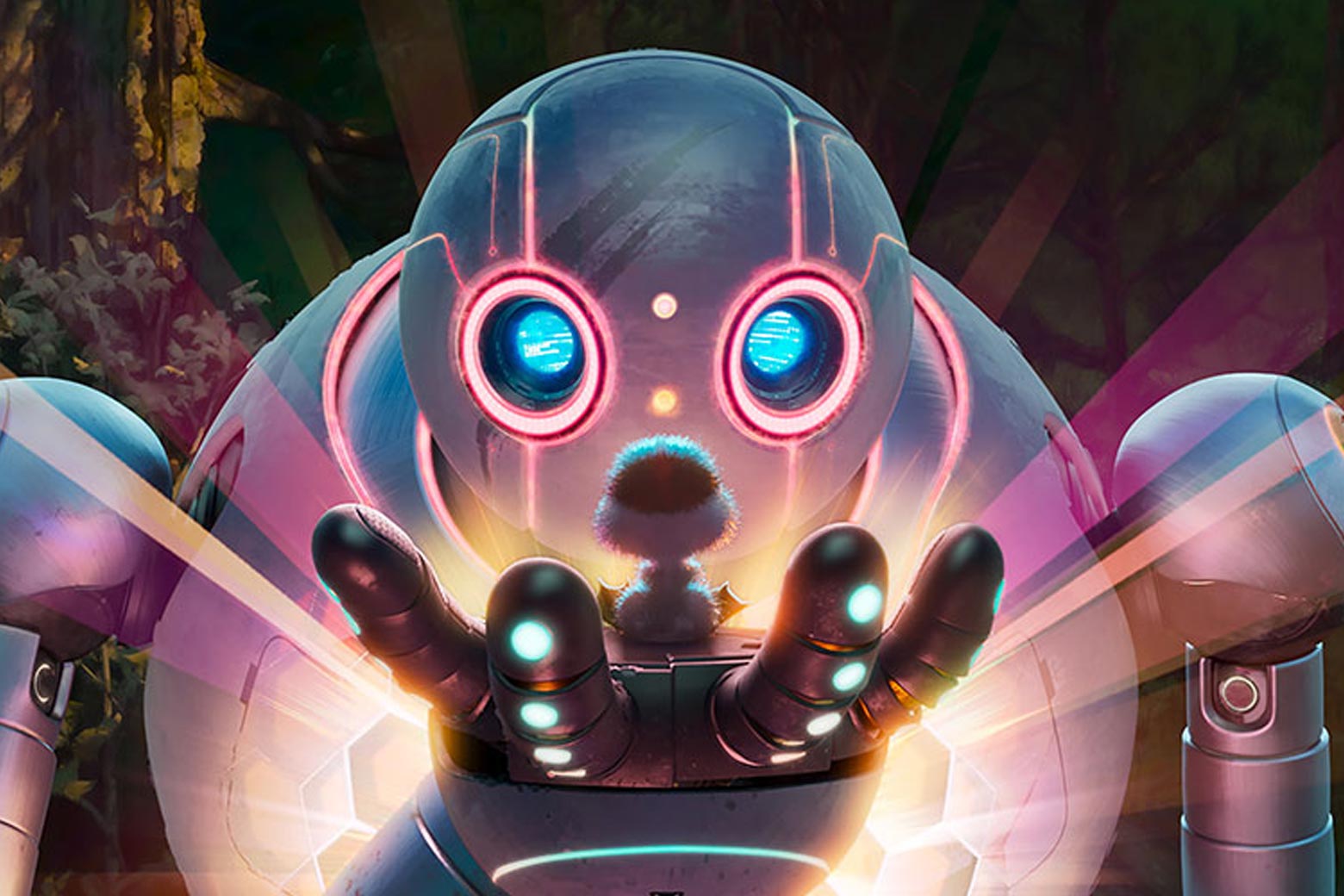
From the very first scene of The Wild Robot, the new animated movie from director Chris Sanders (How to Train Your Dragon), adapted from the first in a trilogy of children’s novels by Peter Brown, the viewer is plunged along with the protagonist into a new and alien world. A robot washes up on the shore of a lushly forested island, surrounded by the flotsam of some sort of wrecked vehicle—a plane? a spacecraft?—and immediately begins scanning the area for someone she can help. Rozzum Unit 7134, voiced by Lupita Nyong’o and soon to be known as “Roz,” has been designed to, as she puts it, offer “integrated, multifaceted task accomplishment” to whatever human requests it of her. The problem is, the island where she’s washed up has no human inhabitants, and the animals witnessing the arrival of this hulking metal biped regard Roz as nothing but a menacing predator to be either fought or fled.
A witty time-lapse montage shows the robot powering down for a bit so her software can learn to decode the animal sounds around her, enabling her to communicate with all the island’s denizens. Unfortunately, once she awakes from this semihibernation and begins to speak to them, the animals are more afraid of her than ever. Except for one: a newly hatched gosling that imprints on her as its mother after Roz, racing to escape an angry bear, accidentally crushes the nest of the chick’s mother and siblings. At first the robot regards this adorable chirping pest as an impediment to her goal of sending a signal to the company that created her, Universal Dynamics, so that she can be located and shipped to her original destination. But the built-in programming that impels Roz to fulfill the needs of this small being before she can move on to her next task gradually begins to give way to a different set of internal commands: the exhausted sense of obligation and ambivalent-yet-unwavering commitment otherwise known as motherhood.
Aided by her few allies in the animal world, including a wily but lonely fox named Fink (Pedro Pascal) and a harried opossum mom, Pinktail (Catherine O’Hara), Roz sets about raising the gosling, whom she dubs Brightbill (Kit O’Connor), to maturity. An elder goose voiced by Bill Nighy informs Roz that she has until autumn to teach the youngster to eat, swim, and fly on his own, so that he can be a part of the mass migration that enables his species to survive. But Roz finds that even the most sophisticated aerodynamic diagrams of geese in flight are insufficient teaching tools for a parent without her own pair of wings to flap. Still, by combining the forces of instinctual nature and technologically enhanced nurture, she and Fink—who’s become a kind of wiseass uncle to the now-teenage goose—strive to get Brightbill ready for the journey.
Though Roz remains laser focused on her “directive”—to borrow a term from another surprisingly moving animated film about an environmentalist robot—other questions begin to creep in. Who designed her to fulfill that destiny, anyway? And why should she leave the island that she has become a part of, right down to the moss and tiny flowers sprouting from the cracks in her metal frame? The second half of the movie gives the robot a whole new set of problems to solve, using not her factory-built superintelligence but the emotional skills she has begun to develop from her relationship with her adopted son (a word, like love, that does not come naturally to a being engineered to provide little more than polite customer service).
The Wild Robot is a magnificent family film, though not one for very young children—I’d say, consulting my own parental databanks, that my kid would have loved it starting around age 9 or 10 but found it too scary before that. Like Felix Salten’s classic book Bambi, a Life in the Woods—a forest fable that’s far darker than its Disney adaptation—The Wild Robot takes place in a nature that’s unapologetically red in tooth and claw. There are no graphic on-screen deaths, but the fact of interspecies predation is casually and even comically referenced throughout. In particular, the offspring of Pinktail the possum serve as a kind of fuzzy Greek chorus, reminding us that, for small mammals like themselves, death is an ever-looming possibility. But in the cozy ecological world this movie establishes, being eaten is as ordinary a part of life as eating. The slow integration of the robot into the animal community is itself a kind of organic process; anyone expecting an antitechnology parable will be surprised to find an almost utopian tale about the coexistence of machines and the natural world, as Roz explores ways to use both her built-in software and her newfound heartware to help her fellow creatures survive.
Unlike most contemporary animated movies, The Wild Robot has a visual style closer to traditional 2D animation than to the modeled three-dimensional look of your average movie from, say, DreamWorks, the studio that released this one. The soft, painterly look of the island and its creatures at first contrasts with the shiny metallic texture of the robot’s spherical body. But as Roz starts to go “wild,” even replacing a damaged part of one metal leg with a beaver-gnawed tree stump, the animation style shifts subtly in its differentiation of her surface from those of the foliage and fur that surround her. With equal subtlety, Nyong’o’s vocal performance changes from suggesting one of those aggravatingly polite synthesized voice assistants—think Siri and Alexa—to sounding like a creature first puzzled by and then open to the uncertainty and wonder of being alive. From a robot consisting of little more than two metal spheres and a clanking set of limbs, she creates a character of enormous complexity and, ultimately, lovability. It seems odd to class a performance in which the actor is never seen as among her best, but Rozzum 7134 is up there with the most memorable people—or metal facsimiles thereof—Nyong’o has yet created on-screen.
There were a few third-act developments that kept me from finding the ending of The Wild Robot as satisfying as it could have been. One important story point felt curiously rushed through, and the last scene, while moving, left a lingering question unresolved. These omissions may be deliberate choices to leave room for a sequel (though a postcredits stinger seemed to exist more to generate a send-off gag than to set up the next chapter). I wouldn’t say no to a complete Wild Robot screen trilogy, especially if Nyong’o, Pascal, and the rest of the stellar voice cast return. But, as those death-obsessed baby possums love to point out, you never know how long what you love will stick around. So if this unusually thoughtful exploration of parenthood, emotional connection, and the coexistence of nature and technology is the only installment we get, load your offspring onto your back and tote them to the movie theater while you can.