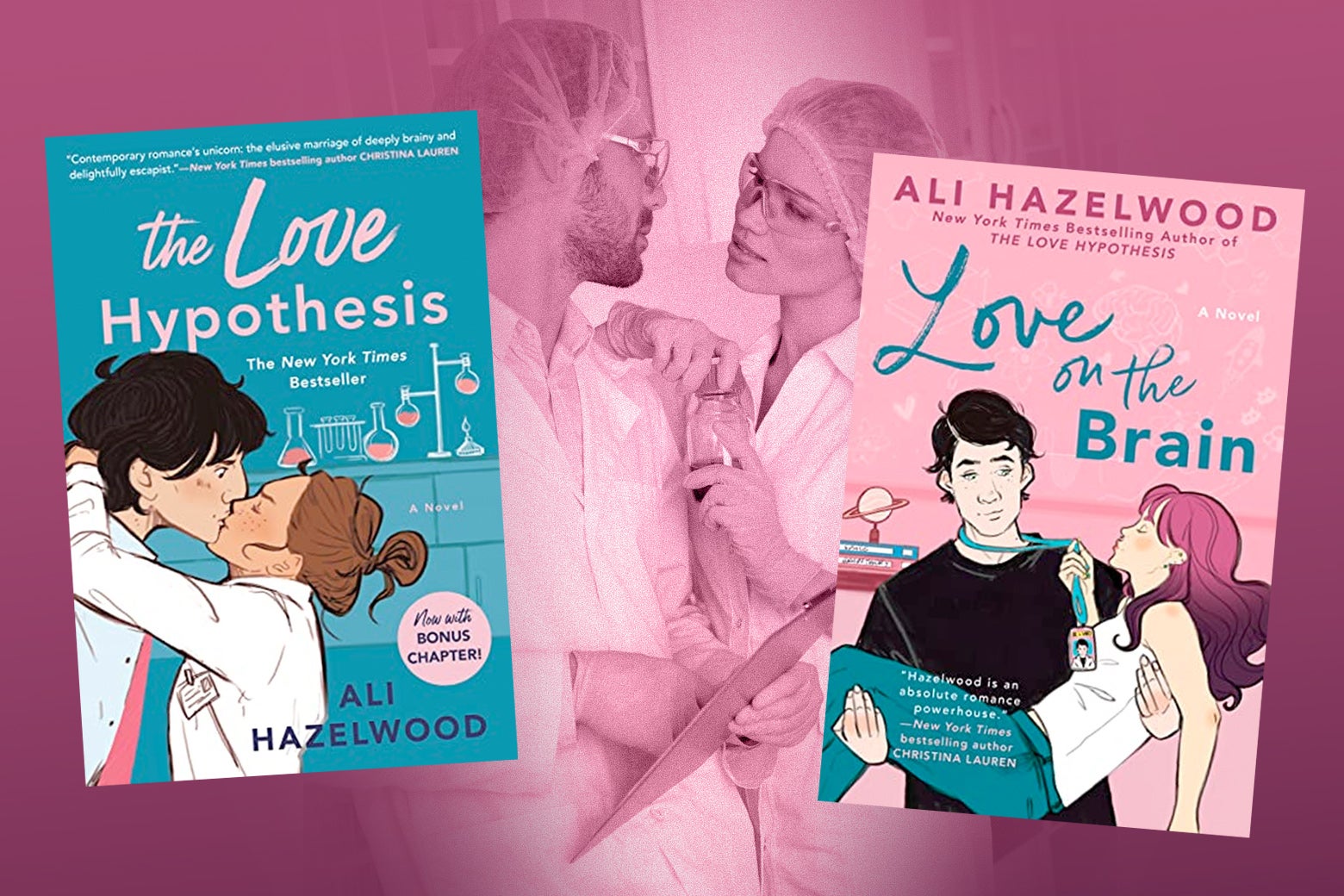
Romance novels are hot right now, and super-involved readers on TikTok and Instagram tend to have very specific tastes—two related facts that have led to big sales for certain niche subgenres within romance writing. Ali Hazelwood, an Italian expat who has lived all over the world but eventually immigrated to the U.S. to pursue an academic career in neuroscience, is among the writers who’ve benefited. Hazelwood is a pseudonym that an anonymous professor, now employed full time in academia, uses to publish a series of novels that tend to get tagged “STEMinist” on BookTok. Her books follow women as they navigate the political, ever-confusing, and at times exploitative world of STEM academia, and have struck a serious chord with audiences.
The publication of Hazelwood’s first novel, The Love Hypothesis, was a result of a fortuitous stroke of luck after a literary agent stumbled across her Star Wars fan fiction. Hypothesis became a New York Times bestselling book in 2021, as well as a common entry into many annual best romance reads and best summer reads lists. Since then, the mysterious professor known as Ali Hazelwood has published Love on the Brain, as well as Loathe to Love You, a collection of three novellas, both of which were NYT bestsellers. The film rights to The Love Hypothesis were optioned last year.
Her new one, Love, Theoretically, which publishes on Tuesday, follows a physicist in the throes of an on-campus interview for a faculty job that will save her from the horrific world of adjuncting, who, of course, falls in love with the one person on the hiring committee who is hellbent on making sure she doesn’t get the gig. I spoke to Hazelwood about Love, Theoretically, the mini-genre of STEM-centric romance writing, and why she thinks her books have gained such a strong following. This conversation has been edited and condensed for clarity.
Nadira Goffe: What made you want to start writing “STEMinist” romance novels, as you call them?
Ali Hazelwood: I don’t think I did it on purpose. I don’t think I set out to be someone who just wrote about women in STEM. It was more that the first things that I wrote were fan fiction, and I was writing a lot of that when I was in grad school and doing my postdoc. And so it was really fun to take these characters that I loved and kind of transpose them into this setting that was so stressful for me and look at how they would’ve reacted if they had to defend their thesis or take comps or publish a paper.
It was very cathartic for me, especially at the beginning. There was this feeling that I was making fun of my entire professional life and environment by writing fan fiction about stuff like that. And then it kind of seeped into original writing, but mostly it was because I’ve spent my entire life in academia, so it’s what I know best and it’s what comes easiest to me.
You mentioned that STEMinist is a word that your publisher gave to your work. What does it mean to you now?
I don’t know who created [the word]. But to me, all STEMinist means is “as it pertains to women in STEM.” I have seen this a lot used as a hashtag. For example, for years before I published, I would follow a lot of influencers who are women in STEM who would produce content that was relatable to me, and they would sometimes use the hashtag #STEMinist.
But I think that, in the end, it’s really more about women in academia and my specific experience. I guess I am not familiar enough with the humanities environment [to write about it], and I feel like I would mess it up. And I’m sure that my personal experience in STEM is not the same as other women in STEM, you know?
But even then, you write about so many different sciences! You’re a neuroscientist—how do you write about physicists, biologists, and more?
It’s a struggle. And I’m like, “I hope no one looks too closely at this.” You know, I research a lot. My first book was about a biologist, and I’m a neuroscientist, but in my graduate program I had a lot of friends who are biologists. There was a lot of cross-pollination with other programs where we would all hang out together. So, I sort of take a lot of what they would tell me and I remember the struggles that they would have. And sometimes I would just ask them questions when I was writing my fan fiction.
And then, for other things, it’s a matter of researching. One of the novellas that I wrote [Below Zero] I loved, loved, loved writing. It’s set in Antarctica and it’s set at this Mars analog location. And I didn’t even know what a Mars analog was, and I started researching it and it’s the coolest thing ever. So, basically the idea is that they prepare for these missions to Mars in the place that is closest to Mars on Earth. I remember, when I was searching for that, I found blogs written by scientists. This is from back when blogs were things, so, I don’t know, a decade ago? And I was reading these blogs written 10 years ago by these super cool scientists, and it was so much fun. And you get to pick little details and put them in the stories.
Your writing has very specific female protagonists that all have their own quirks, passions, and strong sense of determination. How do you set out to write your female protagonists?
I think I lean a lot into what their insecurities are. And I think it might be because of how the process of starting to write worked for me. Writing, originally, was this hobby that I really needed because I was spending my entire days writing my dissertation and working on something that was incredibly taxing. And so writing fan fiction was something that would allow me to explore more personal things. I try to be honest about what my insecurities are with myself, and I try to explore them with my characters. Like, “What is it that prevents this person from being happy right now, and how can this be fixed, and could this be a love story?”
Obviously there’s no way to know for sure, but if you had to guess, why do you think that you have such a large audience that loves your writing?
I’m going to be honest: I think it’s timing and luck. I mean, I don’t think I’m writing anything that is substantially different from what other authors are writing, but I think I was very lucky because my book kind of came in the middle of the [COVID-19] pandemic and it was a kind of happy, feel-good romance novel, and we all needed that. And so I just kind of got this stroke of luck that my book was picked up by a lot of BookTokkers and Bookstagrammers. So it was kind of a perfect storm of a lot of factors. Because, if I think about it, there are so many other [similar] books that were written before mine that were like … I would say they were better.
About 10 years ago, Sherry Thomas, who’s my favorite writer, wrote this book called The One in My Heart, which is a contemporary romance about this professor of materials science. She’s a woman in STEM, and she ends up having this weird fake dating relationship with a doctor, and she’s a MacArthur fellow. It’s one of my favorite novels ever, but not a lot of people have read that book.
I haven’t heard of that! I will have to read it. But I do think you’re selling yourself a little bit short. I really enjoy your books, especially as a sort of escape even from my own world, journalism and media, which is and isn’t like academia in some ways.
So many people I’ve talked to are like, “I’m not in academia, but I am also in a generally male-dominated world that traditionally has taken people who are like me or look like me and has marginalized them.” A lot of people come to me and tell me that. And I really think it’s kind of the universal experience of feeling like you are the odd person out in a setting. I felt the same when, I don’t know, I was reading Jasmine Guillory’s books and she wrote about high-powered lawyers. I don’t know anything about law. But it still resonated with me the way sometimes characters were treated or the fact that they had to jump through all those hoops.
Obviously you write romance novels, which means that they have some particularly steamy scenes. How do you build sexual tension and attraction between characters in settings like graduate student lounges and labs, which are known to be some of the dullest, most sterile of places?
OK, so I’m going to tell you the truth. In every single Ph.D. program at any given time, there are about 20 people who are having these weird kinds of relationships where everyone knows about it but also no one knows about it. I know from the outside it seems like a very sterile environment, but the truth is that a Ph.D. program takes, I don’t know, 10, 15, 20 young people, and yes, they are doing a lot of work, but they kind of also are young and a lot of them have a little bit of a “Work Hard, Play Hard” mentality.
I remember, whenever we would go to an academic conference, someone would hook up and something weirdly inappropriate would happen. I think the way I build tension in those settings is by introducing very inappropriate things. If you think about The Love Hypothesis, the protagonist is a grad student dating a professor, and they do things that, if I saw them happen in my program, I would be like, “No.” But I like doing that [in books]. That’s what I enjoy making fun of. It’s like when you watch a rom-com on TV and you see the character is having these totally weird experiences and you’re like, “Oh, I’m cringing so hard and I’m loving it.”
In addition to the steamy scenes, your writing also deals a lot with just the horrible things that women in academia have to go through, from being sexually harassed to propositioned as payment for mentorship, to running feminist STEM Twitter accounts to cope and seek or give help to other women in STEM. How much of what you write in terms of these conflicts are things that you or someone you know has personally experienced?
I’ve been relatively lucky. I had two mentors through my Ph.D., and they were women and they were amazing, and I feel like that shielded me from a lot of stuff. But I also was the only woman in my cohort. Out of eight of us, seven were American men, and I was this foreign girl coming in, and it was weird and it was isolating.
The truth is that there is a lot of very subtle sexism in academia that is not over the top, like someone necessarily openly sexually assaulting you. I can think of a million different little things that have happened even in my Ph.D. program, where, for example, a lot of female students knew that you would not want to be alone with this person. Stuff like that.
Love, Theoretically, you said in your author’s note, is maybe your most academic book so far. What did you mean by that?
I think it’s because it really goes into the politics of [what happens] when you have a faculty search. It’s kind of funny: In The Love Hypothesis, which was my first book, Olive is a graduate student, and then in Love on the Brain, Bee is a postdoc. And in the last few years, I myself have gone from being a graduate student to a postdoc to a professor. And the whole experience of interviewing for faculty jobs, applying for faculty jobs, it just is incredibly frustrating. And there are very few jobs. Being able to be in academia is getting harder and harder, getting funding is getting harder and harder, and there are so many politics at play. Adjuncting is getting more and more prevalent. So I just really wanted to talk about this really hard and sometimes ridiculous reality that my friends and I were facing in the last few years.
As far as I know, you have yet to write a sex scene that takes place in an actual lab, and would you? Because I feel like there’s a lot you can dramatically sweep off of a counter.
I 100 percent would. And I want to rectify this now that you have pointed it out. Thank you for letting me know. It will happen.