Sign up for the Slatest to get the most insightful analysis, criticism, and advice out there, delivered to your inbox daily.
At a bar downstairs at the Luxor Hotel and Casino in Las Vegas, I recently found myself next to a 67-year-old man who had come to town to get a tattoo on his shoulder. The tattoo in question was of Yosemite Falls, in California. As best I could understand it, he was getting branded with the landmark because he was enmeshed in a situationship that wasn’t working out. He and this woman had apparently taken a memorable trip to Yosemite earlier this year, and he hoped that—after he showed her the tattoo—a tarnished spark would be rekindled. I wished him all the luck in the world as he took his leave of me, and for a few minutes, I was alone among the chirping slot machines, nursing a gin and soda and pondering how no place on Earth can make you believe the impossible quite like Las Vegas.
I know more people who hate Las Vegas than love it, and I’ve never been able to construct a convincing argument for why they’re wrong. We are granted only so many vacations in this life, and it might seem ill-considered to spend one of them watching the Blue Man Group in an Egyptian-themed hotel in the Nevadan desert. But here I was, at the Luxor, on a quest to renew my love affair with this city.
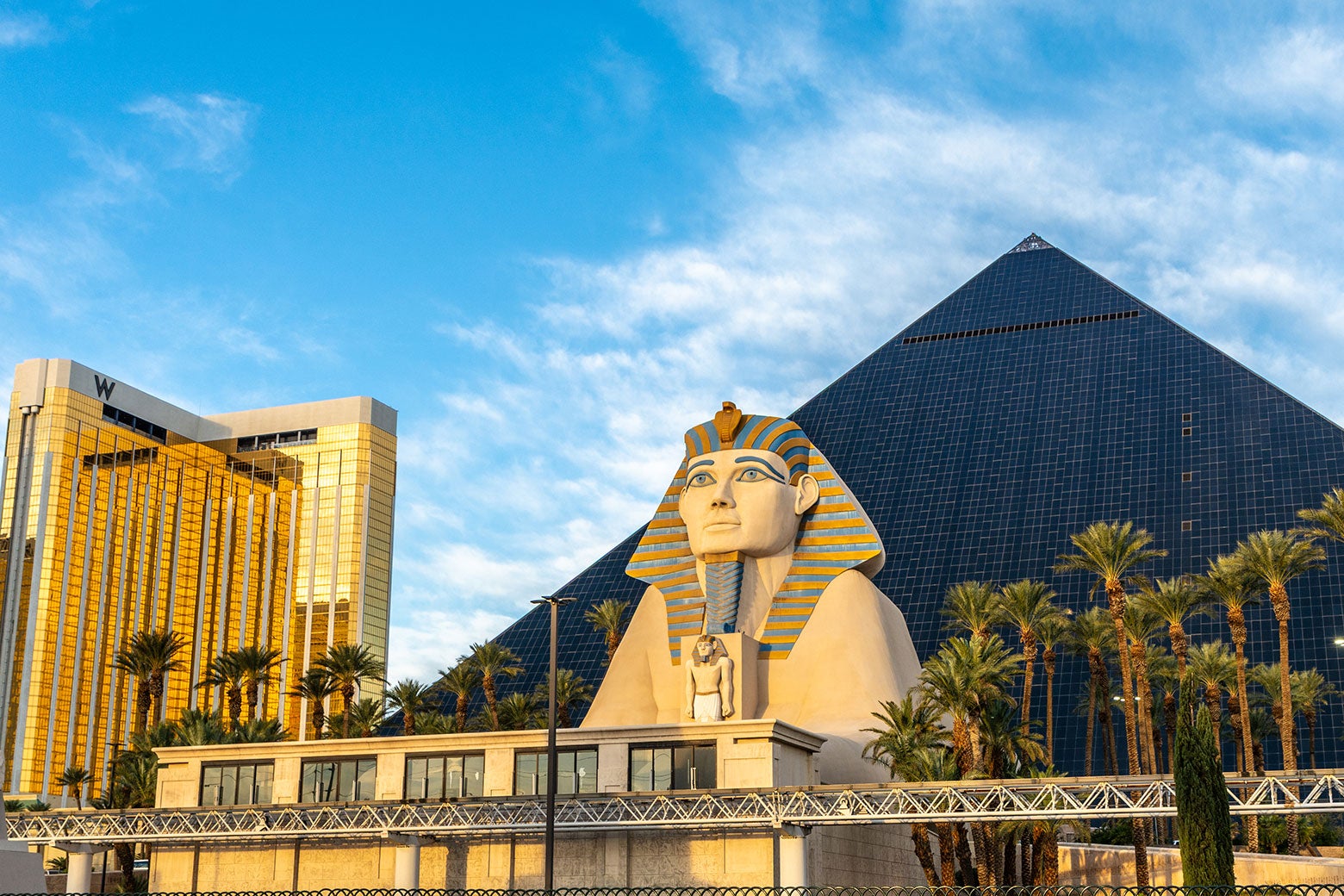
The hotel, located at the tip of the Las Vegas Strip, was once a crown jewel of the city’s famed themed-resort district. The building is a matte-black pyramid, fitted with 4,407 rooms and 65,000 square feet of gaming space, all flourished with pop-Egyptian pastiche. Incoherent hieroglyphs plate the walls, plastic pharaohs stand guard in the check-in lane, and taxis idle under the haunches of a gargantuan Sphinx. I had arrived at the hotel on a balmy afternoon in early autumn and took the elevator to a third-floor suite on the southern face of the pyramid, desert sun pouring through the slanted floor-to-ceiling windows. The resort has long been known as one of the more budget-friendly options in Las Vegas, but it has never been cheaper than it is today. That’s because the Luxor, like so many other hotels in the city, is currently half off.
In September, the Luxor participated in the “Fabulous Five-Day Sale,” a massive weeklong initiative launched by the Las Vegas Convention and Visitors Authority, offering cut-rate deals on restaurants, resorts, and shows across the city. The goal was to coax lapsed vacationers back to America’s sanctum of indulgence, greasing the wheels of a hospitality sector that’s struggled all year long. More to the point, it was a tacit admission that something in Las Vegas had gone awry. Significantly fewer visitors have come to the city in 2025 than they did in 2024, when Vegas hosted more than 41 million travelers, and it’s now facing the worst dip in traffic since the COVID-19 pandemic.
Agitators in the city have attempted to document the deterioration by posting ominous images of barren casinos, conjuring the perception of a place hollowed out by economic armageddon. The reality is more nuanced, but it is true that practically every conceivable indicator tracking tourism to Las Vegas is flashing warning signs. Hotel occupancy has cratered. Rooms were only 66.7 percent full in July, down by 16.8 percent from the previous year. The number of travelers passing through Harry Reid International Airport also declined by 4.5 percent in 2025 during an ongoing ebb of foreign tourists, for familiar reasons. Canadians, historically one of the city’s most reliable sources of degenerates, have effectively vanished. Ticket sales for Air Canada jets flying to Las Vegas have slipped by 33 percent, while the Edmonton-based low-cost carrier Flair has reported a 62 percent drop-off. Those last data points have provoked the city’s mayor, Shelley Berkley, to engage in some emergency diplomacy. In September, she implored our neighbors from the north to make their prodigal return to the Strip.
“I’m telling everyone in Canada, please come,” she said. “We love you, we miss you, we need you.”
Where did everyone go? Nobody seems to know for sure. It’s clear that the city is in the midst of a rough season. What is more vexing is diagnosing what the issue actually is. Are there some obvious, observable problems to explain the swoon? To a certain extent, yes. Vegas has grown more expensive in recent years—hotels and restaurants have gotten pricier, gambling more extractive. But complaints about the cost of leisure have also hampered every other city in America. Tourism is down nationwide, even if destinations like New York City and Los Angeles haven’t suffered as much as Vegas. The terminal plunge of Canadian visitation, meanwhile, is almost certainly related to Donald Trump’s goading the nation at every opportunity. This trend is set to continue into 2026, with experts forecasting as much as a 6 percent drop in foreign visitation to the United States, curtailing tourism sectors all across the country.
But what’s ailing Vegas might be harder to quantify than any material factor—closer to spiritual rot than pure economic tumult. Multiple generations of Americans have been socialized to believe that a mecca of cheap, dirty pleasures awaits in the wastelands of southern Nevada. And for a long time, that was basically true. The mythology of Las Vegas is all-day buffet counters as big as football fields, of David Copperfield tickets that cost the same as a cup of coffee, of indoor cigarettes and comped drinks and the irresponsible ideas those forces can summon in tandem. Las Vegas took your money with gracious respect for your degeneracy, gouging you sweetly and slowly. The magnitude of excess saturated time itself. Somehow, no matter how much you lost at the casino—and you will lose at the casino—it always felt as if you got your money’s worth.
These days, though, that dream is in tatters. Millions of people seem to have determined that Las Vegas has become corroded—its joys less accessible, its humiliations too dire. And that is precisely why I, a longtime devotee of the city, found myself at the Luxor for a three-day stint in October. If Las Vegas was truly in decline, I wanted to see for myself what had gone so wrong. And boy did I.
John and Kristina Mehaffey, the husband-and-wife duo who run the gambling news website Vegas Advantage, asked to meet me at Harrah’s, one of the chintzier casinos on the Strip, located just up the road from Madame Tussauds. Vegas Advantage is famous for its obsessively updated database, which tracks the city’s gambling landscape. If a game room has just installed a fresh band of blackjack felt, the Mehaffeys are the first to know. I reached out to them because I wanted a tour of the infamous triple-zero roulette wheels, which have become a symbol for latter-day Las Vegas hubris. These tables were unheard of in the city until 2016, when two of them made landfall in the bowels of the luxe Venetian. The game has since proliferated across the Strip, for one reason: Every time a player sits down for a few spins of triple zero, they’re getting ripped off.
The Mehaffeys escorted me past the blinking slot machines and into the pit, where we sidled up alongside a gaggle of players peering over the wheel—watching the silver ball zip along the rim. John explained the math: A standard roulette table has 36 numbers—half red, half black. Hit your number, and you’re paid 35 to 1; bet on a color, and you double your money. Quantitatively speaking, a roulette wheel fashioned this way would be totally fair. “Theoretically, over a million spins, you’d get 100 percent of your money back,” said John.
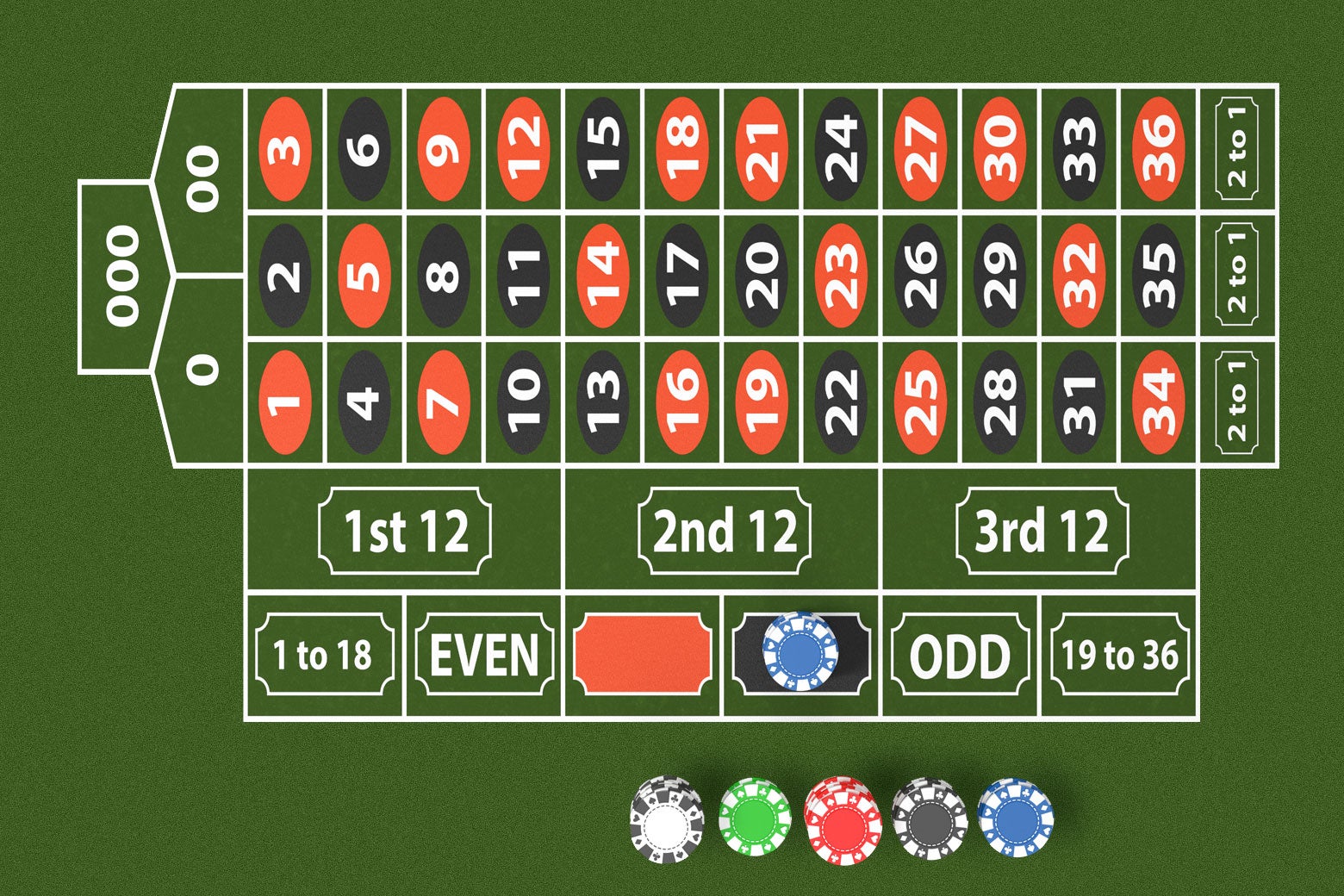
Where the house maintains its edge is in the two additional numbers foisted upon the roulette wheel, a single zero and a double zero, both painted green. With those digits in place, betting on red or black is no longer a 50/50 proposition, and if a player is lucky enough to score a win on a 7, or a 12, or a 28, they’re still making what they bet back by a multiplication of just 35—despite the fact that those green spaces allow for 38 potential outcomes. All this is to say that each zero added to a roulette table increases the revenue it scrapes from players by 2.7 percentage points. So, in a moment of incredible audacity, the power brokers of Las Vegas decided to sharpen their advantage, festooning a gauche and unsightly triple zero to their wheels, plundering our wallets more efficiently than ever before.
Why would anyone put up with those bad odds? That’s not quite the right question to ask. Later on in the day, I watched a bachelor party descend upon a triple-zero wheel, despite that, right next to them, bathed in fluorescent light, a double-zero table—encircled by empty seats—waited for customers. The serene, vodka-buzzed tourists either didn’t know or didn’t care that they were inches away from a much better deal. Vegas happily feasted upon that ambivalence all night long.
Vegas seems to have exported its triple-zero philosophy across the Strip. Another casualty is blackjack, which remains the most popular casino attraction in the city. Historically, the game has followed a golden rule. If you are dealt 21—an ace and a 10—you’ve hit blackjack, and your wager is paid out on a 3-to-2 ratio. (A $100 bet nets $150, and so on.) But Vegas has since altered the rules. Now, on most tables, blackjack is rewarded with a 6-to-5 equation; that same $100 kicks back only $120, significantly curtailing just how lucky someone is allowed to get. Again, it’s not hard to see why Vegas casinos made the change. “They’re tripling the house edge,” John told me. “It went up from about 0.66 percent to 2 percent.”
Even if a gambler is willing to tolerate these perversions of tradition, the price of admission in Vegas has skyrocketed. According to John’s research, in 2020, 38 casinos in the greater Las Vegas gambling market featured tables dealing 3-to-2 blackjack capped at a $5 minimum bet. (As in, to play, you need to risk at least $5 per hand.) These days, that group has dropped to six casinos. Prowl through the Strip after dark, sift through the pits, and you’ll feel the difference. Most table games in 2025 force patrons to sacrifice painful amounts of cash to its maw—$25 minimums are basically standard. Fifty-dollar minimums aren’t uncommon either. Even more deviously, some Vegas properties force customers to pay a premium to access friendlier rules. I came across exactly one ultra-rare single-zero roulette wheel on the Strip, which felt a little bit like uncovering the hutch of the last surviving dodo. Naturally, it was stowed away in a high-limit room.
John told me that Vegas initially ratcheted up its minimums during the pandemic in reaction to the crunch of COVID-era gambling. Social-distancing mandates limited the number of players that could gather at casino tables, so operators made up the difference in scale—squeezing more money out of the few gamblers risking infection to play. It is less clear why those juiced wagers stuck around once the coronavirus receded, outside of the obvious: Gamblers are willing to pay them.
Oliver Lovat, a real-estate consultant at the Denstone Group who serves as an adviser to several Vegas casino properties, said I needed to understand that cheaper games are no longer economically prudent in the city. Between inflation, upkeep, and labor costs—including a Nevada minimum wage that jumped to $12 last year—Lovat argued, the salad days of low-minimum blackjack have been legislated out of the fray. After all, it is telling that no matter how much Vegas tourism declines, the city’s gambling revenue continues to tick upward. In August, gaming revenue on the Strip increased by 5.5 percent. Downtown, it was by over 8 percent, and the Boulder Strip was up almost 10.
“It’s not viable to run a $5 blackjack table anymore. You will lose money running $5 blackjack,” Lovat said. “Now, some places still have it. But they’re running it at a loss.”
It might seem wise to make room for smaller bankrolls in the city—the soul of Las Vegas is contingent on budget travelers—but those appeals are invariably ignored. Like so many other pleasures of modern life, Las Vegas is increasingly becoming a city financed by private equity. Harrah’s Entertainment, the gambling company that owned the casino where I met the Mehaffeys, was sold to a pair of equity sponsors in 2008 for $27.8 billion. One of those firms was Apollo Global Management, a New York–based real-estate holdings group that in 2022 made a play for the iconic Venetian hotel. That pattern has continued across the Strip. Blackstone, the commercial real-estate giant, entered sale-leaseback agreements for the Bellagio in 2019 and picked up the MGM Grand and Mandalay Bay in the years afterward. Blackstone would later sell some of those investments to Vici Properties, a real-estate investment fund founded in 2017, which owns a total of 54 casinos. The mom-and-pops have been bought off, the copper wiring is stripped, and as so often is the case with Wall Street, that tends to be the plan all along.
“The casinos on the Strip are no longer being driven by personalities at leadership. They’re being driven by corporate politics. So they have a different attitude about how you treat your consumers,” said Andrew Woods, director of the Center for Business and Economic Research at the University of Nevada, Las Vegas. “Why wouldn’t the resort industry find a way to maximize shareholder value by nickel-and-diming their consumers? Especially when, until very recently, those consumers haven’t pushed back.”
His point recalled a conversation I had with Jacob Orth, better known by his online moniker JacobslifeinVegas, who has been publishing YouTube videos about Las Vegas for the past 11 years. In earlier eras of his channel, Orth’s videos had a frothy self-help flair; he doled out advice on how to best enjoy some of the more revelrous temptations the city has to offer. (His best-performing upload is titled “5 Ways Las Vegas Prostitutes Scam You.”) Lately, though, Orth’s repertoire has grown increasingly despondent as he chronicles the sense of precipitous decline pervading the Strip. His second-most-popular video was published three months ago. The title: “Why Nobody Wants to Visit Las Vegas Right Now.”
Orth told me a story that he thinks illustrates what has changed. Two years ago, he dumped a couple thousand dollars into a slot machine with the intention of losing his way into a free room. This is a classic Vegas ritual; there is a long history of casino managers giving away free meals, drinks, and lodging to whales willing to risk a tremendous amount of money on their property. The plan worked, and a few weeks later, Orth received a letter in the mail inviting him back to the casino with a complimentary suite. However, rather than the red-carpet treatment he expected—the licentious glamour of earlier epochs in the desert—Orth found the whole process oddly onerous. He ate a conspicuous “resort fee” on his room to the tune of $90. He was told if he made the booking over the phone, he would be charged $15 more. Early check-in, meanwhile, would cost another $60. When Orth finally got into the suite, he found the bathroom covered with questionable splotches. When he asked the front desk for a different room, the attendant inquired about his membership tier.
All told, the experience left Orth with a feeling shared by a lot of people who’ve traveled to Vegas lately. “Can I just get a clean room without having another fee thrown at me?” he said. “It’s like, ‘Do you guys even want me here?’ ”
Contrary to popular belief, the drop in tourism hasn’t rendered Las Vegas a ghost town. The internet billows with sobering images of derelict casinos and abandoned food halls, often emblazoned with apocalyptic all-caps exhortations of doom: “5 Reasons Why Las Vegas is DYING!” And, sure, if you squint, maybe the foot traffic at the Luxor looks a little soft on a Wednesday. But walking down the Strip, there’s no doubt that the social architecture of the city remains sturdy enough.
One morning, I passed into the gaudy marble corridors of Caesar’s Palace and mixed it up with some degenerate boomers, all ashing cigarettes, sipping martinis, and dumping payloads of cash into an array of slot machines before the clock even struck noon. I asked one woman, a Midwesterner with a clipped accent, if she had heard anything about a Vegas slump. “That’s the rumor,” she replied sarcastically, moments after the icons on her screen cascaded in glorious alignment, amounting to a sizable jackpot. If the city is in the midst of a protracted downfall, she’s yet to see it herself.
Indeed, despite the troubling tourism metrics, Las Vegas is undeniably in a moment of big-ticket expansion. The city has added NFL and NHL teams over the past few years, and a baseball team is scheduled to move to town in 2028. The Sphere is a legitimate phenomenon, looming over the skyline with alien grandeur, hosting everyone from the Backstreet Boys to the Kamala Harris campaign. And later this month, the third annual Las Vegas Grand Prix will rumble down the Strip, further solidifying the city’s partnership with Formula One, an arrangement that was just renewed until 2027. All of these endeavors ought to provide fresh blood for the hospitality sector.
So who, exactly, is feeling the crunch? I get my answer when I bumped into Sarah, a 56-year-old selling timeshares and day-trips outside a CVS. She has been working this hustle for nearly three decades. This year has been her worst yet.
“It used to be packed no matter what time it was,” she told me, gesturing to the concrete thoroughfares of the Strip’s southern reaches, which were thin with pedestrians. “Now you see these empty sidewalks.” Sarah makes the bulk of her money on commission, which has been difficult in the uncertainty gripping Las Vegas. (Over the summer, one of her most profitable shifts, a Friday afternoon, was contracted out of existence.) When I asked why Sarah thinks she’s reaching fewer customers, she actually pointed her finger toward the marquee additions to the Vegas cityscape. “They say the F1 race brings a lot of money here, but we don’t see it,” she said. “The people coming aren’t spending money in the hotels. They’re not walking the streets.”
You may find it difficult to summon a ton of empathy for timeshare hawkers, but traipsing through the malaise of modern Vegas, it’s clear that just about everyone in Sarah’s position is struggling. The basic theory goes something like this: With the city angling toward a more affluent market, the marginal titillations of Las Vegas are getting skipped over. At least, that’s the take of a listless showgirl, whose wreath of red peacock feathers exploded out of her leotard as we spoke. “Everyone is spending their money on other stuff,” she said. She typically charges customers $60 for a photo, and even with the Strip steadily growing more expensive—when a snapshot with a busker costs roughly the same as a burger and beer—her financial model has broken.
“In six years of showgirling, this has been my worst summer,” said a different young woman, this one dressed in a purple leotard. “It feels like business is down 80 percent.”
Farther down the Strip, I chatted with a convincing Captain America, whose chiseled jawline and sandy blond hair were betrayed only by his height, about 5-foot-10. He gave me the exact same complaints as the showgirls. “This is more of a job now than it used to be. When I wake up to go to work, it feels more like a grind,” said Cap, who was flanked by miscellaneous other cosplayers—a Transformer, a Stitch—all loitering by a carousel. They were here to feed off Venmo accounts belonging to the parents of enthralled children, and none of them seemed to be around at the moment.
“It seems like international travelers are down. These hotels are charging $200 per night,” he added. “Tourists are just fed up.”
It went on like this. Those who subsist on the fringes of the Vegas tourism orbit are aware that they are in a funk but are nonetheless powerless to fix it. A silent Pennywise—holding a red balloon—wiggled one claw left to right, in a “so-so” motion, when I asked how business had been lately. A male model, shirtless, clenching his biceps in the Excalibur Hotel, had noticed a decrease in traffic to his show, Thunder Down Under, essentially an Australia-centric take on Chippendales. (He’d like to start booking more gigs out of state during the downturn.) I rode the escalator up to an anonymous resort restaurant, and the bartender assured me that while his job is safe, some of the more recent hires at the casino he works in have watched their shifts dwindle into nothing. “You used to be able to come to Las Vegas and spend 6 bucks on a steak this thick,” he said, pinching his fingers 3 inches wide. “That doesn’t happen anymore.” In a related matter, the mediocre fajitas I ordered cost $40.
Later that day, I met a man named Mike, who has scratched out a living selling Cirque du Soleil tickets from a modest wooden stall underneath the colossal shadow of the Strip casinos. He estimated that his business dropped 50 percent this summer, and he had all the usual suspicions as to why. “I was just talking to some Texans—they told me they go to Oklahoma to gamble now,” Mike said. “There’s no resort fees. You can get a beer there for a couple bucks.”
With Las Vegas shedding its reputation for cheap thrills, I wonder what will become of him and all the others who, in previous incarnations of this city, existed in symbiosis with other budget travelers—the aunts and uncles, the grandmas and grandpas—who only ever wanted to spin the penny slots and pose with the girls.
At the midpoint of my most recent time in Vegas, I resolved to witness the foreclosure of the Las Vegas dream for myself. I ventured across the Strip from the Luxor to the MGM Grand, a casino streaked with dollar-bill-green neon in the vacant desert night. My goal was to retake the exact same steps that began my love affair with Las Vegas. It started a decade ago, when a long-defunct media company flew me into the valley to cover a computer game tournament. I checked into my room at the Hard Rock Hotel and Casino—a resort famous for exhibiting a Union Jack minidress that had once belonged to Ginger Spice—and quickly realized that, outside of a couple of perfunctory interviews with catatonic teens, I didn’t have much to do with myself. Most gambling habits are incubated through a combination of aimless curiosity and dangerous opportunity, and this was no different. I took out $200 from the ATM, a not-insignificant amount of money for me at the time, and bellied up to the blackjack table.
What followed would permanently alter my brain chemistry. These were the days of $5 minimums, which meant that my stack of chips would be bled away gracefully, deep into the chthonic night. Inconsequential wins and losses spread out for hours on end, my money gently oscillating with the tide. Cocktail waitresses bearing trayfuls of whiskey sodas materialized out of thin air, lubricating the vibes. The veterans coached me on the rudiments of the game; I learned how to split aces, I learned to never double down on 12. At one point, after hitting two blackjacks in a row, I savored the sublime act of playing with house money. The drinks kept coming, phone numbers were exchanged, inside jokes gained inebriated salience. There was talk of hailing a taxi to a strip club, or hitting the craps table, or buying a couple packs of Marlboro Reds, until finally, at around 3 a.m., I rode the elevator back up to my floor, 100 bucks richer. I don’t think I ever saw the light of day.
It should not surprise you that I eventually lost all that money. The following morning, I returned to the pits of the Hard Rock Hotel and Casino and reignited the ritual, without the same luck. I had scaled the mountaintop of profitability, but, like every other gambler I have ever known, I found that the desire to prolong the euphoria of the weekend had sealed my fate. After my final wager went bust, I pivoted to the bar—where, unfortunately, the drinks were no longer on the house. When I think back on those indelible first days in Vegas, it was not the thrill of victory that seduced me. What surprised me was how much I enjoyed giving in to my worst instincts. Those $200 in chips made the questions of financial responsibility that loomed over me in every other avenue of my life gloriously incorporeal. I was there for as long as the ride was going to take me.
And so, upon entering the wide-open foyer of the MGM Grand, I once again retrieved $200 from the ATM, eating an $11 convenience fee in the process. I plopped down at a blackjack table brimming with other wayward souls and settled in for what I hoped would be a long night.
There was just one problem. This table, like every other I saw at the casino, required—you guessed it—a $25 minimum bet. Back in 2015, a $200 bankroll could be neatly divided into 40 different wagers. Now I was looking down at eight. Half an hour later, I held on 19, and the dealer turned over a 20. She swiped away my last chip from the felt. I hadn’t even had time to order a drink.
All at once, my fond memories of Las Vegas were permanently condemned to the past. It seemed like a betrayal to me, but funnily enough, none of the other tourists I spoke to around town appeared to feel the same way. Over and over again, I heard the exact same refrain from the visitors ambling around the Strip. To them, Vegas was the same city it’s always been, mostly because they had no reason to think otherwise.
I can’t really blame them. The scam gains velocity—the numbers keep going up—but only the dedicated hustlers are capable of identifying the crime. Most people coming to the Strip aren’t going to be counting the number of zeros on a roulette wheel, and even if they did, it wouldn’t prevent them from sitting down for a few spins. That makes those objecting to the changing face of the city a dying breed. You need to be a true degenerate for Las Vegas to break your heart.
The following morning, on my last day in the city, I made a trip into the belly of the beast. Every October, the weeklong Global Gaming Expo takes up residence in the Venetian convention hall. It is, essentially, a showcase of the casino industry’s incredible scope and unlimited capital. Booths stretched out forever, all flush with the many component parts that add up to a successful gaming operation. One vendor touted a display of cushioned leather chairs manicured to fit the precise dimensions of a blackjack table; another presided over chunky green motherboards optimized to swindle cash more efficiently than previous generations of tech.
The glitziest exhibits belonged to the slot-machine manufacturers. They were the ones with the open bars, the gabbing salespeople, and the display of blinking cabinets set to free-play mode. Patrons pressed the buttons again and again, accumulating a pile of cash locked deep within the hardware. The player-friendly artifice that defines so much of Las Vegas was absent here. The business of gambling has only ever been about driving unfathomable capital. It was almost refreshing to be in a place where nobody was afraid to admit it.
I wondered if the vendors had concerns about the Vegas tourism swoon. And, sure, some of them were ringing alarm bells. John Smallwood, the president of Travel Outlook—a company that fields customer phone calls to 300 hotels and casinos—told me that he has seen a startling 25 percent drop in call volume nationwide, a trend he lays at the feet of the president. “This administration has an arrogance about it,” Smallwood said. “And that offends people that aren’t from here.” Other businesspeople floated more-outlandish theories. Jon Friedberg, CEO of the tech company PokerAtlas, correlated the chilly tourism in the city with the rash of air-travel incidents that had colored the news at the beginning of 2025. But the most memorable conversation I had was with a man who works for a gambling company that told me that he was hard at work on software that would remove the last vestiges of friction stopping someone from dumping their hard-earned wages into his casinos. In the future, he says, you’ll be able to tap your phone on a slot machine to load it up with cash, in the same way you might buy a latte, eschewing the need for an ATM and keeping butts in seats for longer than ever before. “They see that slot machine, and they enter a hypnotic state,” he said of his target customer. “They’re willing to lose the $100 because it’s entertainment.”
Naturally, the executive didn’t seem especially worried about the Strip’s visitation numbers. And, frankly, he probably shouldn’t be. Las Vegas, no matter what happens to it, will continue to make a lot of money. The city might be dying, but it will never be dead.
I took the long walk back to the Luxor, prepared to make the most of the few hours I had afforded myself off the clock. There remains, even in this diminished state, a magic to Las Vegas, and I tried to attend to it the best way I could. In practice, that meant that I wove between the casinos—all with their doors swung wide open, prepared, on principle, to welcome absolutely anyone—taking sly little sips from a miniature bottle of Jack Daniel’s stuffed in my back pocket. Two hundred more dollars, this time retrieved from my own checking account rather than the travel budget, burned in my wallet. I hemmed and hawed all afternoon about my willingness to eat shit again, but when I arrived at the hotel, a sense of inevitability had settled in about how the night would unfold. I took my seat at the edge of a blackjack table—paying, you guessed it, 6-to-5—eager to see what kind of mess I would make.
After a couple of lucky breaks, I found myself with a small profit. And even more surprisingly, I had the discipline to venture toward the payout window. The cashier counted out $160, enough to effectively erase the beating I had taken at the MGM Grand. But the spirit of degeneracy had firmly gripped me. The elevator back to my room might as well have been in the next state, and it felt great. So I chose a slot machine at random and fed it those crisp $20 bills. It had some sort of Arabian Nights theme—a magic lamp trembled with anticipation, a sultry genie, midriff exposed, danced across the screen. After I tapped the spin button on the console, the whole machine seemed to erupt. Incomprehensible icons locked into the columns, all bearing numbers that read unbelievably, impossibly high. When the dust settled, I had somehow scored $900. It was, by far, the best night I’ve ever had at a casino.
I wish I could tell you I respected the improbability of the windfall by immediately retreating to my suite. But no, I churned through 100 more bucks—back at the blackjack table—before finally listening to my better angels. Back in my room, I lay in bed and splayed out the cash in my hand, sending a photo of the bounty to my wife, who was surely fast asleep. The horrible truth, for all of us gamblers, is that a delirious trip to Las Vegas is still possible. All of the disappointments dissipate with one lucky spin. I guess they’ve got me for life.