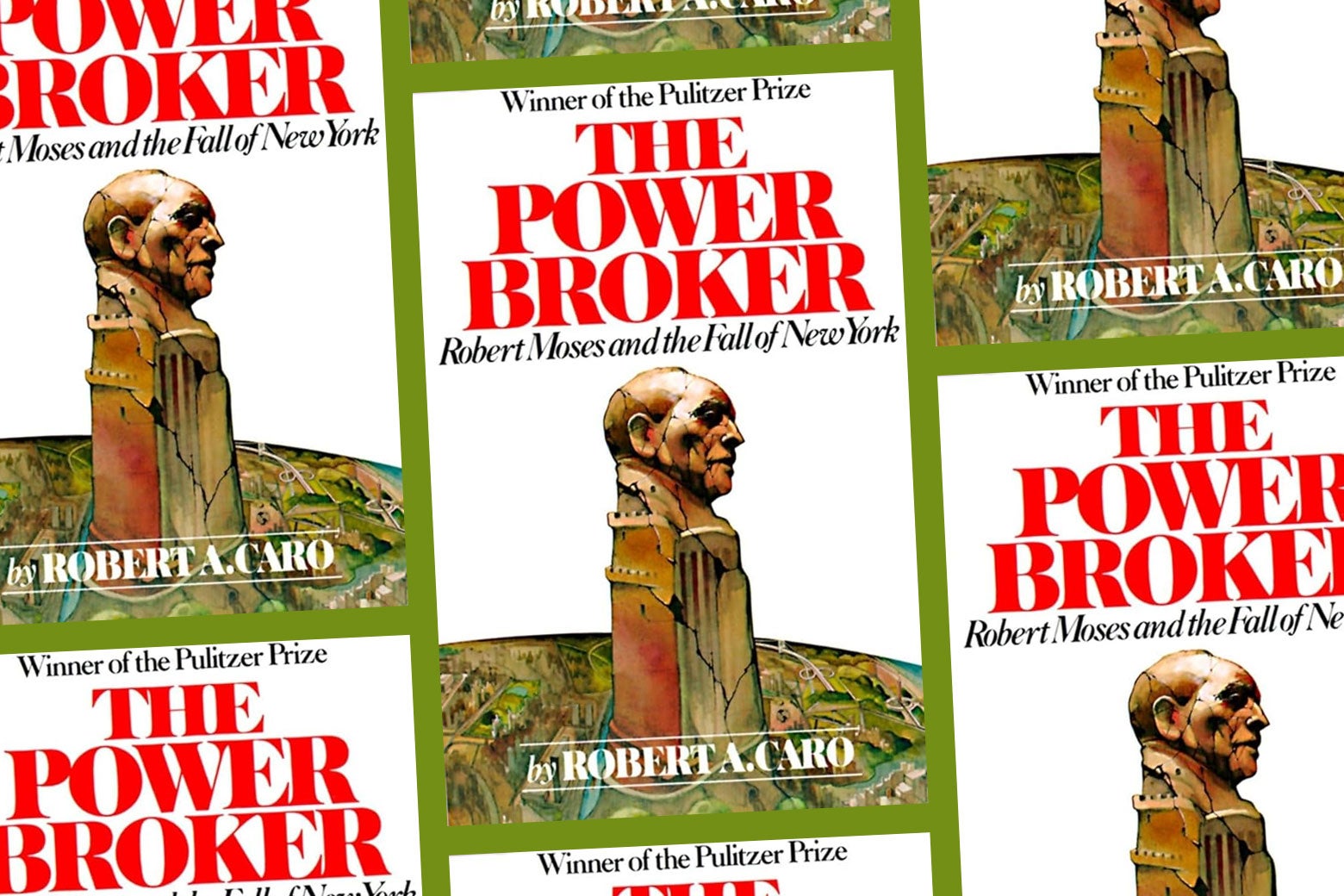
It’s been 50 years since the publication of The Power Broker, Robert Caro’s magisterial biography of New York City master builder Robert Moses.
Perhaps you’ve heard: The New York Times declared 2024 “the year of The Power Broker,” and New York magazine critic Christopher Bonanos argues that reading it—or saying you have—has become an item on young New Yorkers’ adult checklist. Just in the past decade, the book has inspired an opera, a play, and a movie, and it now has its own exhibit at the New-York Historical Society. Mayor Eric Adams says the 2.3-pound tome is his favorite book about the city (though he’s tight-lipped about his takeaways).
Its influence is not confined to New York: The Power Broker has been cited by Barack Obama and Pete Buttigieg. The 1975 winner of both the Pulitzer and Francis Parkman prizes is a book-club Goliath and a Room Rater fixture; proof, on Zoom and otherwise, of deep thinking about urban history. The podcast 99% Invisible has run a yearlong reading group whose thoughtful, laugh-out-loud chapter discussions have been downloaded more than 4 million times. And The Power Broker also sells 40,000 copies a year—a huge figure for any book, let alone a 50-year-old, 1,300-page history—and that’s before the first digital edition came out on Monday.
Indeed, The Power Broker is a spellbinding biography that wraps a busy half-century around the finger of a single, unforgettable protagonist. Moses was “America’s greatest builder,” the corrupt, cruel, arrogant man who constructed highways, bridges, parks, and housing projects on a scale not seen before or since.
But some historians have complained that the great-man story obscures our sense of American urban history, mythologizing Moses, sidelining his peers, and overstating his impact. At 50, the book’s totemic status adds new complications, casting all that happened outside New York and after 1974 into shadow. It has been a long 50 years, and as a guide to the American city, The Power Broker leaves us ill-equipped to confront and overcome the challenges that face us today.
As fans of another sprawling good-vs.-evil saga that dominates the worldview of its readers are sometimes told: Read another book!
The Fall of New York
Amid the generally rapturous reception to the book’s publication in 1974, some critics argued that Caro had exaggerated Moses’ singularity and lacked comparative or historical perspective. “Perhaps Moses pioneered,” wrote the historian Richard Wade, “but the physical shape of urban America would look very much the same whether Moses had lived or not.” The builder’s “great success lay in the fact that he was swimming with the tide of history.” Urban renewal czars also cleared out lively urban neighborhoods from Boston to Los Angeles, and no major city was untouched by the urban expressway craze. That was federal policy.
The theorist Marshall Berman, whose family was displaced for the construction of the Cross Bronx Expressway (the tragic story makes up Caro’s finest and most famous chapter, “One Mile”), had a similar view. “Many accounts of the wreck of the Bronx may have placed too much stress on Moses because he was so flamboyantly vicious,” he wrote later. “But his projects got built because they expressed a total elite consensus, both on what to build and on how.”
This revisionist history reached its apotheosis with a 2007 essay collection edited by the historians Kenneth T. Jackson and Hilary Ballon. By that point, Caro’s work was more than three decades old, and New York’s happy fortunes posed another question: If Moses was so uniquely bad, then why had the city fared so much better than its peers? The Power Broker was released the year before the New York City fiscal crisis, with the Bronx fast becoming the national example of urban crisis. Its subtitle—Robert Moses and the Fall of New York, a late addition in the publishing process—captures the grim mood of the era.
But New York didn’t fall. Unlike Newark, Boston, Washington, Philadelphia, Pittsburgh, Baltimore, Buffalo, Detroit, Cleveland, St. Louis, and Chicago, New York has more residents now than it did at midcentury. What’s more, the city’s mass transit system is the national success story: When Robert Moses was born, the New York region accounted for 1 in 5 U.S. transit riders; today it is 1 in 3. So too is its public housing system, another Moses-influenced project, which provides shelter for 360,000 New Yorkers, while others wait for years to get in—even as more recently built high-rises have been demolished in Newark, St. Louis, and Chicago.
“Robert Moses will be remembered as a key actor in the rise of New York, not its fall,” wrote Jackson, the now-retired Columbia University historian and author of suburbanization history Crabgrass Frontier. “Had he not lived … Gotham would have lacked the wherewithal to adjust to the demands of the modern world.”
“The book is so massive and intimidating that other historians have been discouraged from writing about Robert Moses,” he told me last week. “All the people on the Upper West Side love it, but at the end of the day it’s not good history.”
He referred, for example, to the book’s three most infamous anecdotes of Moses’ racist decisionmaking, which have since come in for particular scrutiny: the racist placement of playground monkey decorations (not true, though New York City removed them anyway), the racist parkway bridges (almost no evidence, though the story was recently cited by Transportation Secretary Pete Buttigieg), and the racist intent of public-pool temperatures (very dubious).
The Pendulum Swings Back
Even highway haters (and I count myself among them) must admit that New York has prospered. If it was not because of Moses, it was in spite of him, and the intervening 50 years have brought plenty of other seismic changes to consider. “A whole new generation of immigrants comes to New York in the 1970s,” observed Kara Murphy Schlichting, a historian at Queens College, CUNY, who has taught The Power Broker’s controversies to her students. The share of New Yorkers born abroad doubled between 1970 and 2000, from 18 percent to 36 percent. “If we get ourselves out of blaming Moses, we can focus on these communities. That, in 2024, is far more salient when we think about how power and planning happen in our contemporary city.”
Despite modern politicians’ insistence on using the book as a political compass (in addition to Adams, his mayoral challengers Brad Lander and Jessica Ramos cite its influence), we are living not in the world of Robert Moses but in the one that arose in his absence. The federal interest in cities was already dead by the time Joe Biden entered the Senate; it is the seesaw of disinvestment and private capital, not overpowering government intervention, that has determined the shape of the urban landscape since. “We’ve transferred our rage about Moses to that corporatized development without fully understanding that Moses offers a more complex picture,” said Samuel Zipp, a historian at Brown University and author of another urban renewal history, Manhattan Projects.
The prototypical modern city planner, meanwhile, is closer to Leslie Knope (a character invented, ironically, by a Power Broker superfan), wielding little influence. Beginning in the 1980s, many critics began to say that Caro had been too critical of Moses’ wily, imperious way of getting things done. Don’t those big plans look tempting now, as New York—and the nation—struggles to construct vital infrastructure from high-speed rail and subways to wind farms and transmission lines, and cities stagnate under a blanket of restrictive zoning, cynically deployed environmental law, and suburban community control? What tools do we have to confront the climate crisis?
“In an era when almost any project can be held up for years by public hearings and reviews by community boards, community groups, civic groups, and planning commissions, not to mention the courts, it is hard not to feel a certain nostalgic tug for Moses’s method of building by decree,” the architecture critic Paul Goldberger wrote in 2007. “It may not have been democratic, or even right. Still, somebody has to look at the big picture and make decisions for the greater good.”
Caro’s suspicion of the government’s ability to do good is another product of its post-Watergate, post-Vietnam, post–Great Society moment, argues Jacob Anbinder, a historian and fellow at Cornell University working on a book about the origins of the housing affordability crisis. “The book is absolutely dripping with a very particular kind of 1970s liberal suspicion of centralized political power,” he wrote to me. “Insofar as people use The Power Broker as a guide to inform their own political values today, I think there is a risk of overextending its lessons. It makes no more sense to assume The Power Broker explains New York today any more than it would’ve for New Yorkers in the ’70s to think The Gangs of New York offered trenchant insights about Abe Beame.”
Moses vs. Jacobs
Needless to say, it is not Caro’s fault that he seems to have had the last word, 50 years ago, on such an important topic. Another accident of history is that his subject has become joined at the hip with Jane Jacobs, the writer, economist, and activist who fired up the movement against urban renewal with her 1961 book The Death and Life of Great American Cities. Jacobs barely figures in The Power Broker, but the Manichaean struggle between the malicious Moses and the benevolent Jacobs has become the public’s favorite (only) story of the urban renewal era.
The binary dumbs them both down, and leaves out the liberal aims of urban renewal and the conservatism in the backlash to its failures.
By portraying Moses as an antidemocratic despot, Caro understates the extent to which his actions reflected the mainstream political thinking of the time. With Moses as boogeyman, we are spared the more challenging question: Why did his worst decisions seem like such great ideas to so many people in the first place? “One thing that doesn’t factor into Caro’s book is how aligned those plans are with some of the central institutions of liberalism. I mean, his most powerful backer is the New York Times,” observed Andrew Needham, a historian at New York University. Other Moses allies of the liberal city: labor unions, universities, hospitals, and cultural institutions. Moses was racist, but several of his urban renewal peers, like Ed Logue in Boston or Elizabeth Wood in Chicago, had sincere progressive motives for tearing down and rebuilding cities.
History has been kind to some of Moses’ projects as well. In one of the past half-century’s amusing twists, many of the “slums” and “firetraps” that Moses tried to destroy are now million-dollar co-ops and creative-class rentals paid for by banking salaries (or the Bank of Dad). The middle-class housing with which Moses replaced them, meanwhile—in Chinatown, in Stuy Town, on the Upper West Side, and so on—now constitute some of Manhattan’s last bastions of affordability.
That has fueled doubts about the moral righteousness of the Jacobs-style community control movement that succeeds central planning as the decisionmaking standard in cities. As the planning historian Thomas Campanella wrote in 2011, “The literature on grassroots planning tends to assume a citizenry of Gandhian humanists. In fact, most people are not motivated by altruism but by self-interest.” Today a typical house in Jacobs’ home turf, the fastidiously preserved West Village, sells for more than $10 million. Several contemporary observers have tried to split the difference: Think like Jacobs, act like Moses.
Caro doesn’t deserve blame for that shift any more than Jacobs does, but the enduring popularity of his book suggests a widespread misconception: Many city leaders still see themselves as guardians of the public interest against powerful forces. In reality, the most powerful force in the modern American city is the stultifying status quo. We have met the enemy and he is us.
Annemarie Sammartino is a historian at Oberlin College and the author of Freedomland, a history of Co-op City, the Bronx cluster of housing towers that makes up the nation’s largest residential development and one of Moses’ final projects. This urban housing for the middle class built in collaboration with the city’s unions is another Moses legacy, though its spare, modernist aesthetics repelled preservationists of the Jacobs school.
“Moses represented state power, and the willingness of the state to act, in a situation where if the state does not act, you cede everything to the interest of developers,” said Sammartino, who grew up in the complex, which is still restricted to middle-income households. “Caro’s book is more complex and interesting than the way it gets used, but it’s still a morality tale, and becomes a way to criticize not just planning but also render the newer communities inauthentic, not real, not worthwhile.”
Those maligned modernist projects shine more brightly by the light of gentrification, just as the grand pools look good next to the gilded bauble of Little Island, and the diverse crowd at Jones Beach is a public policy success next to the mostly white private towns of Fire Island, and New York City’s abbreviated central-city highway plan (superman Moses failed where his nameless peers succeeded) is a blessing compared with the destruction of New Haven or Cincinnati.
And in Co-op City? A six-room apartment costs about $50,000, and the maximum income for a family of four is $160,000. Occasionally, our sense of what matters most changes over time. It is as Caro says in the book’s epigraph: “One must wait until the evening to see how splendid the day has been.”